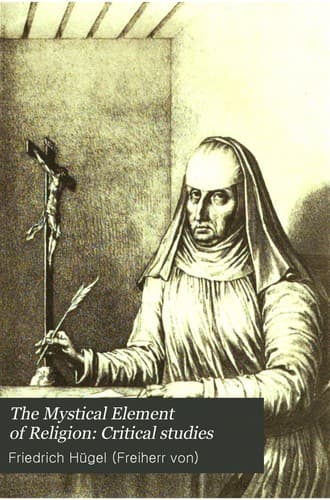
The Mystical Element of Religion, as studied in Saint Catherine of Genoa and her friends, Volume 2 (of 2)Hügel, Friedrich, Freiherr von
Religion
The Mystical Element of Religion, as studied in Saint Catherine of Genoa and her friends, Volume 2 (of 2)
Hügel, Friedrich, Freiherr von
Catherine, of Genoa, Saint, 1447-1510
According to his own deepest, most deliberate, and most systematic
teaching, it is the life of Christ, the living Christ, energizing even
now within the faithful soul, that constitutes both the primary source
and the ultimate motive of Christian sanctity. “I am crucified with
Christ; nevertheless I live, yet not I, but Christ liveth in me.” And
through this divine-human life within us “we faint not; but though our
outward man perish, yet the inward man is renewed day by day.” Indeed
the Lord Himself said to him: “My grace is sufficient for thee; for
power is made perfect in infirmity”; and hence he, Paul, could declare:
“Gladly therefore will I glory in my infirmities, that the power of
Christ may dwell in me.” And thus, with Christ living within him, he
can exclaim: “If God be for us, who shall be against us?… Who shall
separate us from the love of Christ? shall tribulation, or peril, or
the sword?… In all these things we are more than conquerors, through
him that loved us. For I am persuaded that neither death nor life,
nor things present nor things to come … shall be able to separate us
from the love of God.” “Whether we live, or whether we die, we are
the Lord’s.”[156] We thus get here a reinsistence upon, and a further
deepening of, perhaps the profoundest utterance of the whole Old
Testament: “What have I in Heaven besides Thee? and besides Thee I seek
nothing upon earth. Even though my flesh and my heart faint, Thou art
my rock and my portion for ever.”[157]
And then that deathless hymn to Pure Love, the thirteenth chapter of
the First Epistle to the Corinthians, not only culminates with the
proclamation that, of all man can hope and wish and will and do, of
all his doings and his graces, “there remain these three, Faith, Hope,
Love, (Charity): but the greatest of these is Love (Charity).” But
the Love that has this primacy is Pure Love, for “it seeketh not its
own.” And though of this Love alone it is said that “it never passeth
away,” ever persists in the Beyond: yet even here already it can and
does get exercised,--and this, not only without any suppression of
parallel acts of the other virtues, but with these other virtues and
their specific motives now taken over and deepened, each in its special
characteristic, by the supreme virtue and motive of Pure Love: “Love
believeth all things, hopeth all things, beareth all things.”[158] Thus
Faith, Hope, Patience, and all the other virtues, they all remain,
but it is Love that is now the ultimate motive of all their specific
motives. These, his culminating teachings, indicate clearly enough that
virtue’s rewards are regarded by him, ultimately and substantially, as
“the wages of going on and not to die”; or rather that they are, in
their essence, manifestations of that Eternal Life which is already
energizing, within souls that earnestly seek God, even here and now.
This Life, then, however great may be its further expansion and the
Public-domain text, read in full here on John Shaqi.
Reviews
Reviews
No reviews yet
Be the first to share your thoughts on this work.
Elsewhere in the archive
Join the Discussion
Join the discussion
Sign in to leave a comment or review.
Sign InorCreate an account