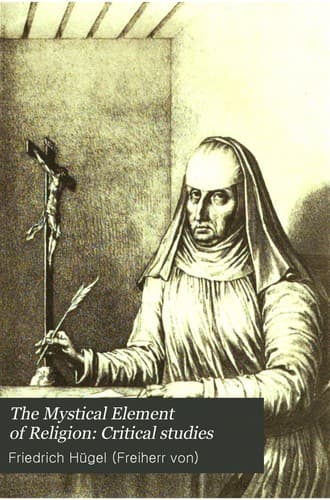
The Mystical Element of Religion, as studied in Saint Catherine of Genoa and her friends, Volume 2 (of 2)Hügel, Friedrich, Freiherr von
Religion
The Mystical Element of Religion, as studied in Saint Catherine of Genoa and her friends, Volume 2 (of 2)
Hügel, Friedrich, Freiherr von
Catherine, of Genoa, Saint, 1447-1510
But in this instance we have to make a further distinction--viz.
between the objective drift of at least part of his _Explication des
Maximes des Saints sur la Vie Interieure_, published in 1697, and
especially the twenty-three propositions extracted from it which
were condemned by Pope Innocent XII in 1699; and the teaching which
he increasingly clarified and improved in his numerous apologetic
writings against Bossuet and other opponents in this memorable
controversy--especially in his Latin writings, intended for
transmission to the Pope, and written as late as 1710 and 1712.[159]
It is certain that Bishops and theologians who opposed his _Maximes_
were found warmly endorsing such pieces as his wonderfully clear and
sober _Première Réponse aux Difficultés de M. l’Evêque de Chartres_.
It is these pieces, comprising also his remarkably rich _Instruction
Pastorale_, his admirably penetrating _Lettre sur l’Oraison Passive_
and _Lettre sur la Charité_, and his extraordinarily compact and
balanced Second Epistle to Pope Clement XI, 1712 (where all the
censured ambiguities and expressions are carefully avoided), and which
alone among Fénelon’s writings shall be accepted in what follows.[160]
Indeed even the earlier of these writings fail in but one thing--in
justifying the actual text of the condemned book, as distinguished
from the intentions of its writer. Bishop Hedley sums up the real
position with the treble authority of a spiritually trained Monk,
of a practised theological writer, and of a Catholic Bishop of long
experience: “The doctrine intended by Fénelon, in his _Maximes des
Saints_, and as explained by him during his controversy with Bossuet,
has never been censured, although the opposite party laboured hard for
its condemnation. Fifteen years after the condemnation of his book, we
find him re-stating to Pope Clement XI (who, as Cardinal, had drawn up
the Brief of his condemnations), in careful scholastic language the
doctrine intended by himself, but which he himself had misstated in his
popular treatise. As there were errors, the other side, whatever the
crudity or novelty of some of its contentions, whatever its motives or
methods--and some of them were far from creditable--was sure in the end
to succeed. And it is well that it should have succeeded as far as it
did succeed.”[161]
Public-domain text, read in full here on John Shaqi.
Reviews
Reviews
No reviews yet
Be the first to share your thoughts on this work.
Elsewhere in the archive
Join the Discussion
Join the discussion
Sign in to leave a comment or review.
Sign InorCreate an account