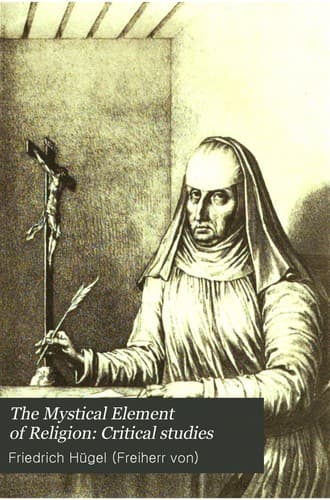
The Mystical Element of Religion, as studied in Saint Catherine of Genoa and her friends, Volume 2 (of 2)Hügel, Friedrich, Freiherr von
Religion
The Mystical Element of Religion, as studied in Saint Catherine of Genoa and her friends, Volume 2 (of 2)
Hügel, Friedrich, Freiherr von
Catherine, of Genoa, Saint, 1447-1510
Now all this fits in admirably with the whole Jewish-Christian respect
for, high claims upon, and constant training of the body, the senses,
the emotions, and with the importance attached to the Visible and
Audible,--History, Institutions, Society.--Yet our difficulties are
clear. For however spiritually we may conceive a bodily survival or
resurrection; however completely we may place the identity of the
various stages of the body in this life, and the sameness between
the body before death and after the resurrection, in the identity of
its quasi-creator, the body-weaving soul, we can in nowise picture
to ourselves such a new, indefinitely more spiritual, incorporation,
and we bring upon ourselves acute difficulties, for both before and
after this unpicturable event. Before the resurrection there would
have to be unconsciousness between death and that event; but thus
the future life is broken up, and for no spiritual reason. Or there
would be consciousness; but then the substitute for the body, that
occasions this consciousness, would, apparently, render all further
revivification of the body unnecessary. And if we take the resurrection
as effected, we promptly feel how mixed and clumsy, how inadequate,
how less, and not more, than the best and noblest elements of our
experience and aspirations even here and now, is such a, still
essentially temporal and spacial, mode of existence.
I take it that, against all this, we can but continue to maintain
two points. The soul’s life after bodily death is not a matter of
experience or of logical demonstration, but a postulate of faith and a
consequence from our realization of the human spirit’s worth; and hence
is as little capable of being satisfactorily pictured, as are all the
other great spiritual realities which can nevertheless be shown to be
presupposed and implicitly affirmed by every act of faith in the final
truth and abiding importance of anything whatsoever.--And again, it is
not worth while to attempt to rescue, Aristotle-wise, just that single,
and doubtless not the highest, function of man’s spirit and character,
his dialectic faculty, or even his intellectual intuitive power, for
the purpose of thus escaping, or at least minimizing, the difficulties
attendant upon the belief in Immortality. If we postulate, as we do,
man’s survival, we must postulate, without being able to fill in or to
justify any details of the scheme, the survival of all that may and
does constitute man’s true and ultimate personality. How much or how
little this may precisely mean, we evidently know but very imperfectly:
but we know enough to be confident that it means more than the
abstractive, increasingly dualistic school of Plato, Philo, Plotinus,
Proclus would allow.
Public-domain text, read in full here on John Shaqi.
Reviews
Reviews
No reviews yet
Be the first to share your thoughts on this work.
Elsewhere in the archive
Join the Discussion
Join the discussion
Sign in to leave a comment or review.
Sign InorCreate an account