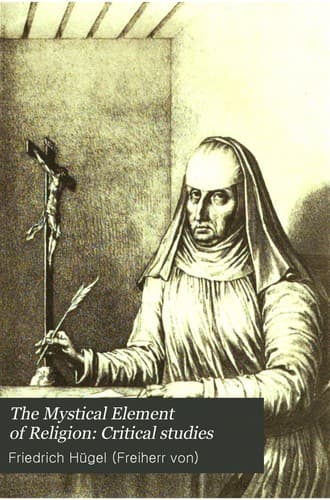
The Mystical Element of Religion, as studied in Saint Catherine of Genoa and her friends, Volume 2 (of 2)Hügel, Friedrich, Freiherr von
Religion
The Mystical Element of Religion, as studied in Saint Catherine of Genoa and her friends, Volume 2 (of 2)
Hügel, Friedrich, Freiherr von
Catherine, of Genoa, Saint, 1447-1510
And under our last, fourth head, we can group the simplifications
characteristic of Catherine’s Eschatology.
(1) One simplification has, of course, for now some fifteen hundred
years, been the ordinary Christian conception: I mean the elimination
of the time-element between the moment of death and the beginning of
the three states. Yet it is interesting to note how by far the greatest
of the Latin Fathers, St. Augustine, who died in A.D. 430, still clings
predominantly to the older Christian and Jewish conception of the soul
abiding in a state of shrunken, joy-and-painless consciousness from
the moment of the body’s death up to that of the general resurrection
and judgment. “After this short life, thou wilt not yet be where the
saints will be,” _i.e._ in Heaven. “Thou wilt not yet be there: who
is ignorant of this? But thou canst straightway be where the rich
man descried the ulcerous beggar to be a-resting, far away,” _i.e._
in Limbo. “Placed in that rest, thou canst await the day of judgment
with security, when thou shalt receive thy body also, when thou shalt
be changed so as to be equal to an Angel.”[216] Only with regard to
Purgatory, a state held by him, in writings of his last years, 410-430
A.D., to be possible, indeed probable, does he make an exception to
his general rule: for such purification would have to take place” in
the interval of time between the death of the body and the last day of
condemnation and reward.”[217]
It is doubtless the still further fading away of the expectation, so
vivid and universal in early Christian times, of the proximity of Our
Lord’s Second Advent, and the tacit prevalence of Greek affinities and
conceptions concerning the bodiless soul, that helped to eliminate,
at last universally, this interval of waiting, in the case of souls
too good or too bad for purgation, from the general consciousness
of at least Western Christendom. The gain in this was the great
simplification and concentration of the immediate outlook and interest;
the loss was the diminished apprehension of the essentially complex,
concrete, synthetic character of man’s nature, and of the necessity for
our assuming that this characteristic will be somehow preserved in this
nature’s ultimate perfection.
Public-domain text, read in full here on John Shaqi.
Reviews
Reviews
No reviews yet
Be the first to share your thoughts on this work.
Elsewhere in the archive
Join the Discussion
Join the discussion
Sign in to leave a comment or review.
Sign InorCreate an account