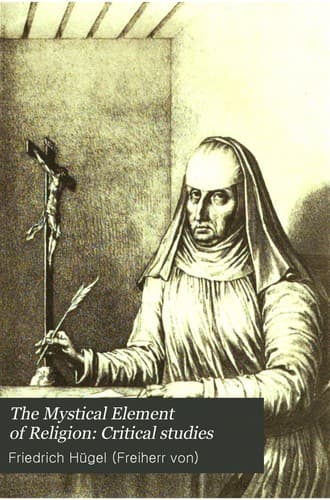
The Mystical Element of Religion, as studied in Saint Catherine of Genoa and her friends, Volume 2 (of 2)Hügel, Friedrich, Freiherr von
Religion
The Mystical Element of Religion, as studied in Saint Catherine of Genoa and her friends, Volume 2 (of 2)
Hügel, Friedrich, Freiherr von
Catherine, of Genoa, Saint, 1447-1510
In Pseudo-Dionysius the non-Orphic, purely negative, view prevails:
“Evil is neither in demons nor in us as an existent evil, but as a
failure and dearth in the perfection of our own proper goods.” And St.
Thomas similarly declares that “different souls have correspondingly
different stains, like shadows differ in accordance with the difference
of the bodies which interpose themselves between the light.”[263]
But Catherine, in this inconsistent with her own general
Privation-doctrine, again conceives the stain, the “macchia del
peccato,” as Cardinal Manning has acutely observed, not simply as a
deprivation of the light of glory, but “as the cause, not the effect,
of God’s not shining into the soul”: it includes in it the idea of
an imperfection, weakness with regard to virtue, bad (secondary)
dispositions, and unheavenly tastes.[264]
3. _The true and the false in the Orphic conception._
Now precisely in this profoundly true conception of Positive Stain
there lurk certain dangers, which all proceed from the original Orphic
diagnosis concerning the source of these stains, and these dangers will
have to be carefully guarded against.
(1) The conviction as to the purificatory power of fire was no doubt,
originally, the direct consequence from the Orphic belief as to the
intrinsically staining and imprisoning effect of the body upon the
soul. “The soul, as the Orphics say, is enclosed in the body, in
punishment for the punishable acts”; “liberations” from the body,
and “purifications” of the living and the dead, ever, with them,
proceed together. And hence to burn the dead body was considered
to purify the soul that had been stained by that prison-house: the
slain Clytemnestra, says Euripides, “is purified, as to her body, by
fire,” for, as the Scholiast explains, “fire purifies all things,
and burnt bodies are considered holy.”[265] And such an intensely
anti-body attitude we find, not only fully developed later on into a
deliberate anti-Incarnational doctrine, among the Gnostics, but, as we
have already seen, slighter traces of this same tone may be found in
the (doubtless Alexandrian) Book of Wisdom, and in one, not formally
doctrinal passage, a momentary echo of it, in St. Paul himself.
And Catherine’s attitude is generally, and often strongly, in this
direction.
Public-domain text, read in full here on John Shaqi.
Reviews
Reviews
No reviews yet
Be the first to share your thoughts on this work.
Elsewhere in the archive
Join the Discussion
Join the discussion
Sign in to leave a comment or review.
Sign InorCreate an account