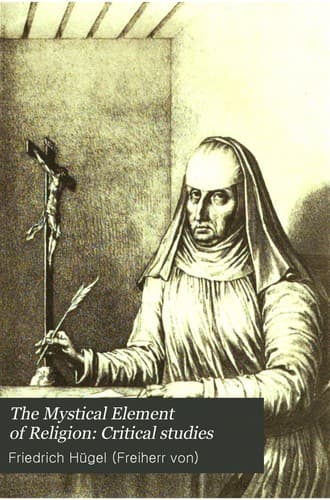
The Mystical Element of Religion, as studied in Saint Catherine of Genoa and her friends, Volume 2 (of 2)Hügel, Friedrich, Freiherr von
Religion
The Mystical Element of Religion, as studied in Saint Catherine of Genoa and her friends, Volume 2 (of 2)
Hügel, Friedrich, Freiherr von
Catherine, of Genoa, Saint, 1447-1510
Yet we must equally guard against making even Our Lord into so
exclusive a centre and home of all that is divine, as to cause Him
to come into an entirely God-forsaken, completely God-forgetting
world, a world which did not and could not, in any degree or manner
whatsoever, rightly know, love, or serve God at all; and against so
conceiving the religion, taught and practised by Him, as to deprive it
of all affinity with, or room for, such admittedly universal forces
and resultants of the human soul and the religious sense as are dim
apprehension, formless recollection, pictureless emotion, and the
sense of the Hiddenness and Transcendence of the very God, Who is also
Immanent and Self-Revealing, in various degrees and ways, in every
place and time. Indeed, these two forces: the diffused Religiosity and
more or less inchoate religion, readily discoverable, by a generous
docility, more or less throughout the world of human souls, and the
concentrated spirituality and concrete, thoroughly characteristic
Religion, which has its culmination, after its ample preludings in the
Hebrew Prophets, in the Divine-Human figure and spirit of Jesus Christ:
are interdependent, in somewhat the way in which vague, widely spread
Subconsciousness requires, and is required by, definite, narrowly
localized Consciousness in each human mind. Precisely because there
have been and are previous and simultaneous lesser communications
of, and correspondences with, the one “Light that enlighteneth every
man that cometh into the world”; because men can and do believe
according to various, relatively preliminary, degrees and ways, in God
and a Providence, in Sin and Contrition, without a knowledge of the
Historic Christ (although never without the stimulation of some, often
world-forgotten, historic personality, and ever with some real, though
unconscious approximation to His type of life and teaching), therefore
can Christ be the very centre, and sole supreme manifestation and
measure of all this light. Not only can Christ remain supreme, even
though Moses and Elijah, Amos and Isaiah, Jeremiah and Ezekiel; and
indeed, in their own other degrees and ways, Plato and Plotinus,
Epictetus and Marcus Aurelius, Gautama Buddha and Rabbi Akiba be all
revered as God-loved and God-loving, as, in various amounts, truly,
spiritually great: but only thus can His central importance be fully
realized.
Public-domain text, read in full here on John Shaqi.
Reviews
Reviews
No reviews yet
Be the first to share your thoughts on this work.
Elsewhere in the archive
Join the Discussion
Join the discussion
Sign in to leave a comment or review.
Sign InorCreate an account