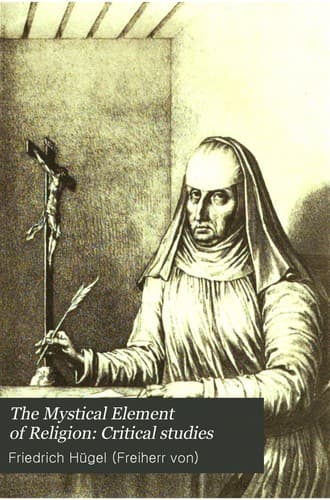
The Mystical Element of Religion, as studied in Saint Catherine of Genoa and her friends, Volume 2 (of 2)Hügel, Friedrich, Freiherr von
Religion
The Mystical Element of Religion, as studied in Saint Catherine of Genoa and her friends, Volume 2 (of 2)
Hügel, Friedrich, Freiherr von
Catherine, of Genoa, Saint, 1447-1510
But what shall we say as to the relations between Religion and
Philosophy? Here again Hermann is the vigorous champion of a very
prevalent and plausible simplification. “There exists no Theory of
Knowledge for such things as we hold to be real in the strength of
faith. In such religious affirmations, the believer demolishes every
bridge between his conviction and that which Science can recognize as
real.” Indeed Hermann’s attitude is here throughout identical with that
of his master, Albrecht Ritschl: Metaphysics of any and every kind
appear everywhere, to both writers, as essentially unnecessary, unreal,
misleading, as so much inflation and delusion of soul.--Yet this again
is quite demonstrably excessive, and can indeed be explained only as an
all but inevitable recoil from the contrary metaphysical excesses of
the Hegelian school.
(1) Since the culmination of that reaction, “it has,” as Prof. H.
J. Holtzmann, himself so profoundly historical and so free from
all extreme metaphysical bent, tells us, “become quite impossible
any further to deny the metaphysical factors which had a share in
constituting such types of New Testament doctrine as the Pauline and
Joannine. Indeed, not even if we were to reduce the New Testament to
the Synoptic Gospels and the Acts on the one hand, and to the Pastoral
Epistles, the Epistle of James and the Apocalypse on the other hand,
would the elements which spring from speculative sources be entirely
eliminated. And since, again, the Old Testament religion, in its last
stage, assimilated similarly metaphysical materials from the East
and from the West; since Mohammedanism, in its Persian and Indian
branches, did the same with regard to the older civilized religions of
Middle and Eastern Asia; since also these latter religions received
a speculative articulation in even the most ancient times, so that
they are both Philosophy and Religion simultaneously: we are forced
to ask ourselves, whether so frequent a concomitant of religion is
satisfactorily explicable as a mere symptom of falsification or decay.”
And whilst answering that the primary organ for religion is Feeling
and Conscience, he points out how large an amount of Speculation was,
nevertheless, required and exercised by a St. Augustine, even after his
unforgettable experiences of the sufferings attendant upon Sin, and of
their cure by Grace alone.[321]
Public-domain text, read in full here on John Shaqi.
Reviews
Reviews
No reviews yet
Be the first to share your thoughts on this work.
Elsewhere in the archive
Join the Discussion
Join the discussion
Sign in to leave a comment or review.
Sign InorCreate an account