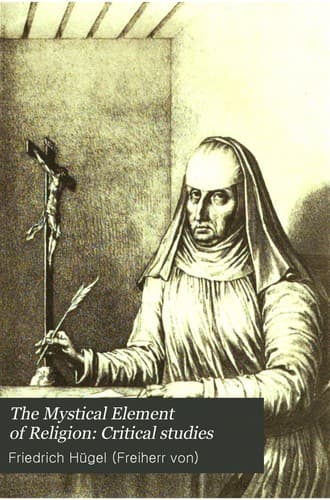
The Mystical Element of Religion, as studied in Saint Catherine of Genoa and her friends, Volume 2 (of 2)Hügel, Friedrich, Freiherr von
Religion
The Mystical Element of Religion, as studied in Saint Catherine of Genoa and her friends, Volume 2 (of 2)
Hügel, Friedrich, Freiherr von
Catherine, of Genoa, Saint, 1447-1510
And if we look, not at seemingly childish fantasticalness in certain
mystical lives, but at the later state of shattered health and
apparently weakened nerve- and will-power which appears so frequently
to be the price paid for the definitely ecstatic type of religion, even
where it has been spiritually fruitful, our anxiety is readily renewed.
Look at the nine, possibly thirteen, last years of Catherine’s, or at
the last period of St. Margaret Mary’s life; note the similar cases
of SS. Maria Magdalena de Pazzi and Juliana Falconieri. And we have
a figure of all but pure suffering and passivity in St. Lidwina of
Schiedam (1380-1433), over which M. Huysmans has managed to be so
thoroughly morbid.
(2) And if such lives strike us as too exceptional to be taken, with
whatever deductions, as a case in point, we can find a thoroughly fair
instance in the life of Father Isaac Hecker. Here we have a man of
extraordinary breadth, solidity, and activity of mind and character,
and whose mysticism is of the most sober and harmonious kind. Yet his
close companion and most faithful chronicler, Father Walter Elliott,
tells us: “From severe colds, acute headaches, and weakness of the
digestive organs, Father Hecker was at all times a frequent sufferer.
But, towards the end of the year 1871, his headaches became much more
painful, his appetite forsook him, and sleeplessness and excitability
of the nervous system were added to his other ailments. Remedies of
every kind were tried, but without permanent relief. By the summer
of 1872 he was wholly incapacitated.” “The physical sufferings of
those last sixteen” (out of the sixty-nine) “years of his life were
never such as to impair his mental soundness … though his organs of
speech were sometimes too slow for his thoughts.” His digestion and
nervous system had been impaired by excessive abstinence in early
manhood, and by excessive work in later life, “till at last the body
struck work altogether. During the sixteen years of his illness every
symptom of bodily illness was aggravated by the least attention to
community affairs or business matters, and also by interior trials,”
although he still managed, by heroic efforts, at times directly to
serve his congregation and to write some remarkable papers. Yet this
state continued, practically unbroken, up to the end, on December 22,
1888.[58] And although the various proximate causes, indicated by
Father Elliott, had no doubt been operative here, there can, in view of
the numerous similar cases, be no question that the most fundamental
of the reasons of this general condition of health was his strongly
mystical type and habit of mind and his corresponding psycho-physical
organization.
Public-domain text, read in full here on John Shaqi.
Reviews
Reviews
No reviews yet
Be the first to share your thoughts on this work.
Elsewhere in the archive
Join the Discussion
Join the discussion
Sign in to leave a comment or review.
Sign InorCreate an account