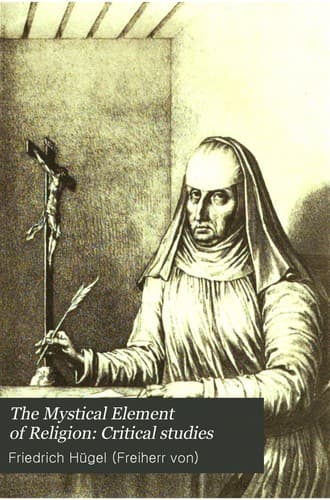
The Mystical Element of Religion, as studied in Saint Catherine of Genoa and her friends, Volume 2 (of 2)Hügel, Friedrich, Freiherr von
Religion
The Mystical Element of Religion, as studied in Saint Catherine of Genoa and her friends, Volume 2 (of 2)
Hügel, Friedrich, Freiherr von
Catherine, of Genoa, Saint, 1447-1510
(3) In view of those fantasticalnesses and of these exhaustions, we
cannot but ask whether these things are not a terrible price to pay
for such states? whether such states should not be disallowed by
all solid morality, and should not prompt men of sense to try and
stamp them out? And, above all, we seem placed once more, with added
anxiety, before the question whether what is liable to end in such sad
general incapacitation was not, from the first, directly productive
of, and indeed simply produced by, some merely subjective, simply
psycho-physical abnormality and morbidness?
(4) Three points here call for consideration. Let us, for one thing,
never forget that physical health is not the true end of human life,
but only one of its most important means and conditions. The ideal man
is not, primarily and directly, a physical machine, perfect as such
in its development and function, to which would be tacked on, as a
sort of concomitant or means, the mental, moral, and spiritual life
and character. But the ideal man is precisely this latter life and
character, with the psycho-physical organism sustained and developed in
such, and only such, a degree, direction, and combination, as may make
it the best possible substratum, stimulus, instrument, material, and
expression for and of that spiritual personality.[59] Hence, the true
question here is not whether such a type of life as we are considering
exacts a serious physical tribute or not, but whether the specifically
human effects and fruits of that life are worth that cost.
No one denies that mining, or warfare, or hospital work, both spiritual
and medical, involve grave risks to life, nor that the preparation
of many chemicals is directly and inevitably injurious to health.
Yet no one thinks of abolishing such occupations or of blaming those
who follow them, and rightly so; for instant death may and should be
risked, the slow but certain undermining of the physical health may be
laudably embarked on, if only the mind and character are not damaged,
and if the end to be attained is found to be necessary or seriously
helpful, and unattainable by other means.
The simple fact, then, of frequent and subsequent, or even of universal
and concomitant ill-health in such mystical cases, or even the proof
of this ill-health being a direct consequence or necessary condition
of that mystical life, can but push back the debate, and simply raises
the question as to the serious value of that habit and activity. Only
a decision adverse to that serious value would constitute those facts
into a condemnation of that activity itself.
Public-domain text, read in full here on John Shaqi.
Reviews
Reviews
No reviews yet
Be the first to share your thoughts on this work.
Elsewhere in the archive
Join the Discussion
Join the discussion
Sign in to leave a comment or review.
Sign InorCreate an account