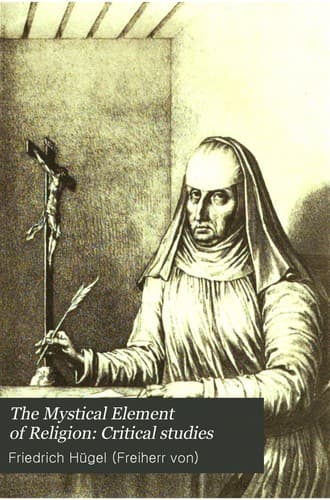
The Mystical Element of Religion, as studied in Saint Catherine of Genoa and her friends, Volume 2 (of 2)Hügel, Friedrich, Freiherr von
Religion
The Mystical Element of Religion, as studied in Saint Catherine of Genoa and her friends, Volume 2 (of 2)
Hügel, Friedrich, Freiherr von
Catherine, of Genoa, Saint, 1447-1510
It is well that the chronological order requires us to begin with
St. Paul, for he is probably, if not the most extensive, yet the
most intense of all these influences upon Catherine’s mind. I here
take the points of his experience and teaching which thus concern
us in the probable order of their development in the Apostle’s own
consciousness,--his pre-conversion assumptions and positions, first
and the convictions gained at and after his conversion or clarified
last;[62] and under each heading I shall group together, once for all,
the chief reactions of Catherine’s religious consciousness.
Now those Pauline pre-conversion assumptions and positions come from
two chief sources--Palestinian, Rabbinical Judaism, (for he was the
disciple of the Pharisee, Gamaliel, at Jerusalem), and a Hellenistic
religiousness closely akin to, though not derived from, Philo, (for he
had been born in the intensely Hellenistic Cilician city Tarsus, at
that time a most important seat of Greek learning in general and of
the Stoic philosophy in particular). And we shall find that Catherine
appropriates especially this, his Hellenistic element; indeed, that at
times she sympathizes rather with the still more intensely Hellenistic
attitude exemplified by Philo, than with the limitations introduced by
St. Paul.
1. _St. Paul’s Anthropology in general._
If we take the Pauline Anthropology first, we at once come upon a
profoundly dualistic attitude.
(1) There is, in general, “the outer” and “the inner” man, 2 Cor. iv,
16; and the latter is not the exclusive privilege of the redeemed,--the
contrast is that between the merely natural individual and the moral
personality. And this contrast, foreign to the ancient Hebrews, is
first worked out, with clear consciousness, by Plato, who, _e.g._,
in his _Banquet_, causes one of the characters to say: “Socrates has
thrown this Silenus-like form around himself externally, as in the case
of those Silenus-statues which enclose a statuette of Apollo; but, when
he is opened, how full is he found to be of temperance within”; and who
treats this contrast as typical of the dualism inherent to all human
life here on earth.[63]--This contrast exists throughout Catherine’s
teaching as regards the thing itself, although her terms are different.
She has, for reasons which will appear presently, no one constant term
for “the inner man,” but “the outer man” is continuously styled “la
umanità.”
Public-domain text, read in full here on John Shaqi.
Reviews
Reviews
No reviews yet
Be the first to share your thoughts on this work.
Elsewhere in the archive
Join the Discussion
Join the discussion
Sign in to leave a comment or review.
Sign InorCreate an account