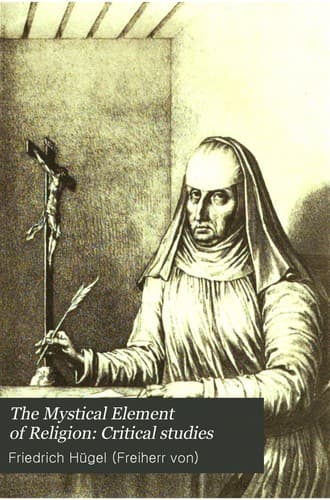
The Mystical Element of Religion, as studied in Saint Catherine of Genoa and her friends, Volume 2 (of 2)Hügel, Friedrich, Freiherr von
Religion
The Mystical Element of Religion, as studied in Saint Catherine of Genoa and her friends, Volume 2 (of 2)
Hügel, Friedrich, Freiherr von
Catherine, of Genoa, Saint, 1447-1510
(2) The “outer man” consists for St. Paul of the body’s earthly
material, “the flesh”; and of the animating principle of the flesh,
“the psyche,” which is inseparably connected with that flesh, and
which dies for good and all at the death of the latter; whereas the
form of “the body” is capable of resuscitation, and is then filled out
by a finer material, “glory.”[64]--Here Catherine has no precise or
constant word for the “psyche”; her “umanità” generally stands for the
“psyche” _plus_ body and flesh, all in one; and her “anima” practically
always means part or the whole of “the inner man,” and mostly stands
for “mind.” And there is no occasion for her to reflect upon any
distinction between the form and the matter of the body, since she
nowhere directly busies herself with the resurrection.
The “inner man” consists for St. Paul in the Mind, the Heart, and the
Conscience. The Mind (_noûs_), corresponding roughly to our theoretical
and practical Reason, has a certain tendency towards God: “The
invisible things of God are seen by the mind in the works of creation,”
Rom. i, 20; and there is “a law of the mind” which is fought by “the
law of sin,” Rom. vii, 23; and this, although there is also a “mind
of the flesh,” Col. ii, 18; “a reprobate mind,” Rom. i, 28; and a
“renovation of the mind,” Rom. xii, 2.--Catherine clings throughout
most closely to the Pauline use of the term, as far as that use is
favourable: note how she perceives invisible things “colla mente mia.”
The Heart is even more accessible to the divine influence,--at least,
it is to it that God gives “the first fruits of the Spirit” and “the
Spirit of His Son, crying Abba, Father,” Gal. iv, 6; 2 Cor. i, 22. As
an organ of immediate perception it is so parallel to the Mind, that we
can hear of “eyes of the heart”; yet it is also the seat of feeling,
of will, and of moral consciousness, Eph. i, 18; 2 Cor. ii, 4; 1 Cor.
iv, 5; Rom. ii, 15. It can stand for the inner life generally; or,
like the Mind, it can become darkened and impenitent; whilst again,
over the heart God’s love is poured out, God’s peace keeps guard, and
we believe with the heart, 1 Cor. xiv, 25; Rom. i, 21; ii, 5; v, 5;
Phil. iv, 7; Rom. x, 9.--All this again, as far as it is favourable, is
closely followed by Catherine; indeed the persistence with which she
comes back to certain effects wrought upon her heart by the Spirit,
Christ,--effects which some of her followers readily interpreted as so
many physical miracles,--was no doubt occasioned or stimulated by 2
Cor. iii, 3, “Be ye an epistle of Christ, written by the Spirit of the
living God … upon the fleshly tables of the heart.”
Public-domain text, read in full here on John Shaqi.
Reviews
Reviews
No reviews yet
Be the first to share your thoughts on this work.
Elsewhere in the archive
Join the Discussion
Join the discussion
Sign in to leave a comment or review.
Sign InorCreate an account