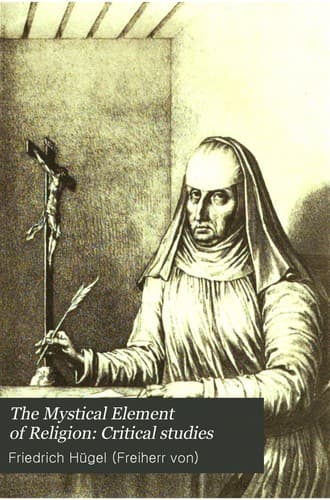
The Mystical Element of Religion, as studied in Saint Catherine of Genoa and her friends, Volume 2 (of 2)Hügel, Friedrich, Freiherr von
Religion
The Mystical Element of Religion, as studied in Saint Catherine of Genoa and her friends, Volume 2 (of 2)
Hügel, Friedrich, Freiherr von
Catherine, of Genoa, Saint, 1447-1510
And this attractive force is also a faculty of Christ: “I shall draw
all men unto Myself,” xii, 32. And note how Catherine, ever completely
identifying God, Christ, Light, Love, and, where these work in
imperfectly pure souls, Fire, is stimulated by the last-quoted text
to extend God’s, Christ’s, Love’s drawing, attraction, to all men;
to limit only, in various degrees, these various men’s response to
it; and to realize so intensely that a generous yielding to this our
ineradicable deepest _attrait_ is our fullest joy, and the resisting it
is our one final misery, as to picture the soul, penitent for this its
mad resistance, plunging itself, now eagerly responsive to that intense
attraction, into God and a growing conformity with Him.
(3) As to points concerning the Sacraments where Catherine is
influenced by John, we find that here again Baptismal conceptions are
passed over by her. She does not allude to the water in the discourse
to Nicodemus, iii, 5, although she is full of other ideas suggested
there; but she dwells upon the water in the address to the Woman at
the Well, iv, 10-15, that “living water,” which is, for her, the
spirit’s spiritual sustenance, Love, Christ, God, and insensibly glides
over into the images and experiences attaching, for her, to the Holy
Eucharist.
But, as to this the greatest of the Sacraments and the all-absorbing
devotion of her life, her symbols and concepts are all suggested by
the Fourth Gospel, in contrast to the Synoptists and St. Paul. For the
Holy Eucharist is, with her, ever detached from any direct memory of
the Last Supper, Passion, and Death, the original, historical, unique
occasions which still form its setting in the pre-Joannine writings,
although those greatest proofs of a divinely boundless self-immolation
undoubtedly give to her devotion to the Blessed Sacrament its beautiful
enthusiasm and tenderness. The Holy Eucharist ever appears with her,
as with St. John, attached to the scene of the multiplication of the
breads,--a feast of joy and of life, with Christ at the zenith of His
earthly hope and power. For not “a shewing of the death” in “the
eating of this bread,” 1 Cor. xi, 26, is dwelt on by John; but we have:
“I am the Bread of Life; he that eateth this bread, shall live for
ever,” John vi, 51, 52.
And Catherine follows John in thinking predominantly of the single
soul, when dwelling upon the Holy Eucharist. For if John presents
a great open-air Love-Feast in lieu of Paul’s Upper Chamber and
Supper with the twelve, he, as over against Paul’s profoundly social
standpoint, has, throughout this his Eucharistic chapter, but three
indications of the plural as against some fourteen singulars.
Public-domain text, read in full here on John Shaqi.
Reviews
Reviews
No reviews yet
Be the first to share your thoughts on this work.
Elsewhere in the archive
Join the Discussion
Join the discussion
Sign in to leave a comment or review.
Sign InorCreate an account