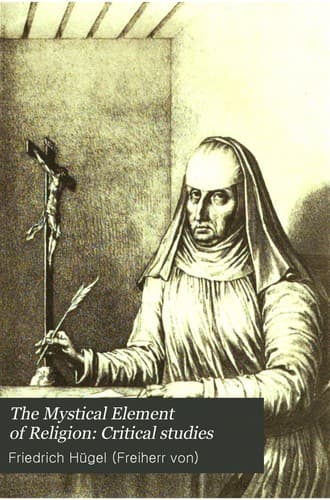
The Mystical Element of Religion, as studied in Saint Catherine of Genoa and her friends, Volume 2 (of 2)Hügel, Friedrich, Freiherr von
Religion
The Mystical Element of Religion, as studied in Saint Catherine of Genoa and her friends, Volume 2 (of 2)
Hügel, Friedrich, Freiherr von
Catherine, of Genoa, Saint, 1447-1510
And even for that one volitional act in the beyond, which, according
to her doctrine, has a certain constitutive importance for the whole
eternity of all still partially impure souls--for that voluntary
plunge--we can find an analogue in the Joannine writings, although here
there is no reference to the after life. For throughout the greater
part of his teaching--from iii, 15, 16, apparently up to the end of the
Gospel,--the possession of spiritual Life is consequent upon the soul’s
own acts of Faith, and not, as one would expect from his other, more
characteristic teaching, upon its Regeneration from above, iii, 3. And
the result of such acts of Faith is a “Metabasis,” a “passing over from
death to life,” v, 24; 1 John iii, 14. Catherine will have conceived
such an act of Faith as predominantly an act of Love, and the act as
itself already that Metabasis; and will, most characteristically,
have quickened the movement, and have altered its direction from the
horizontal to the vertical, so that the “passing, going over,” becomes
a “plunge down into” Life. For indeed the Fire she plunges into is, in
her doctrine, Life Itself; since it is Light, Love, Christ, and God.
Catherine, once more, is John’s most faithful disciple, where he
declares that Life to stream out immediately from the life-giving
object of Faith into the life-seeking subject of that Faith, from the
believed God into the believing soul: “I am the Bread of Life; he who
cometh to Me, shall not hunger”; “he who abideth in Me, and I in him,
beareth much fruit”; vi, 35; xv, 5.
And finally, she follows John closely where he insists upon
Simultaneity and Eternity as contrasted with Succession and
Immortality, so as even to abstract from the bodily resurrection. He
who “hath passed over from death to life” (already) “possesses eternal
life”; “every one who liveth and believeth in Me, shall not die for
ever (at any time)”; “this,” already and of itself, “is eternal life,
to know Thee, the one true God and Jesus Christ Whom Thou hast sent”;
and the soul’s abiding in such an experience is Christ’s own joy,
transplanted into it, and a joy which is full, v, 24; xi, 26; xvii, 3;
xv, 11. And there is here such an insistence upon an unbroken spiritual
life, in spite of and right through physical death, that, to Martha’s
declaration that her brother will arise at the last day, xi, 24, Jesus
answers, “I am the Resurrection and the Life: he who believeth in Me,
even if he die” the bodily death, “shall live” on in his soul; indeed
“every man who liveth” the life of the body, “and who believeth in Me,
shall not die for ever (at any time)” in his soul, xi, 25, 26. John’s
other line of thought, in which the bodily resurrection is prominent,
remains without any definite or systematic response in Catherine’s
teaching.
Public-domain text, read in full here on John Shaqi.
Reviews
Reviews
No reviews yet
Be the first to share your thoughts on this work.
Elsewhere in the archive
Join the Discussion
Join the discussion
Sign in to leave a comment or review.
Sign InorCreate an account