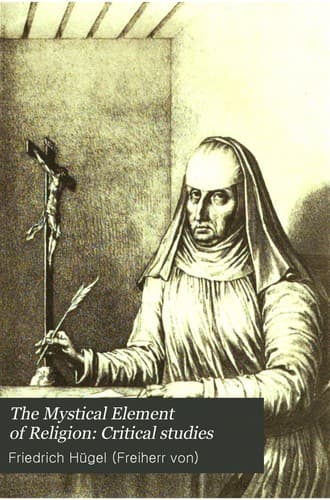
The Mystical Element of Religion, as studied in Saint Catherine of Genoa and her friends, Volume 2 (of 2)Hügel, Friedrich, Freiherr von
Religion
The Mystical Element of Religion, as studied in Saint Catherine of Genoa and her friends, Volume 2 (of 2)
Hügel, Friedrich, Freiherr von
Catherine, of Genoa, Saint, 1447-1510
And Dionysius has the doctrine, so dear to Catherine, that “the Source
of Good is indeed present to all, but all are not,” by their intention,
“present to It; yet, by our aptitude for Divine union, we all,” in a
sense, “are present to It.” “It shines, on Its own part, equally upon
all things capable of participation in It.”[74] Already Plotinus had
finely said: “The One is not far away from any one, and yet is liable
to be far away from one and all, since, present though It be, It is”
efficaciously “present only to such as are capable of receiving It, and
are so disposed as to adapt themselves to It and, as it were, to seize
and touch It by their likeness to It, … when, in a word, the soul is in
the state in which it was when it came from It.”[75]
We have again in Dionysius the combination, so characteristic of
Catherine, of a tender respect for the substance of human nature, as
good and ever respected by God, and of a keen sense of the pathetic
weakness of man’s sense-clogged spirit here below. “Providence, as
befits its goodness, provides for each being suitably: for to destroy
nature is not a function of Providence.” “All those who cavil at the
Divine Justice, unconsciously commit a manifest injustice. For they
say that immortality ought to be in mortals, and perfection in the
imperfect … and perfect power in the weak, and that the temporal should
be eternal … in a word, they assign the properties of one thing to
another.”[76]
2. _Symbols of God’s action._
(1) As to the symbols of God’s action, we have first the Chain or Rope,
Catherine’s “fune,” that “rope of His pure Love,” of which “an end was
thrown to her from heaven.”[77] This symbol was no doubt suggested by
Dionysius: “Let us then elevate our very selves by our prayers to the
higher ascent of the Divine … rays; as though a luminous chain (rope,
σειρά) were suspended from the celestial heights and reached down
hither, and we, by ever stretching out to it up and up … were thus
carried upwards.”[78] And this passage again goes back to Proclus,
who describes the “chain (rope) of love” as “having its entirely
simple and hidden highest point fixed amongst the very first ranks of
the Gods”; its middle effluence “amongst the Gods higher than the
(sensible) world”; and its third, lowest, part, as “divided multiformly
throughout the (sensible) world.” “The divine Love implants one common
bond (chain) and one indissoluble friendship in and between each soul
(that participates in its power), and between all and the Beautiful
Itself.”[79] And this simile of a chain from heaven, which in Dionysius
is luminous, and in Catherine and Proclus is loving, goes back, across
Plato (_Theaetetus_ 153_c_ and _Republic_, X, 61_b_, 99_c_) to Homer,
where it again is luminous (golden). For, in the _Iliad_, viii, 17-20,
Zeus says to the Gods in Olympus, “So as to see all things, do you, O
Gods and Goddesses all, hang a golden chain from heaven, and do you all
Public-domain text, read in full here on John Shaqi.
Reviews
Reviews
No reviews yet
Be the first to share your thoughts on this work.
Elsewhere in the archive
Join the Discussion
Join the discussion
Sign in to leave a comment or review.
Sign InorCreate an account