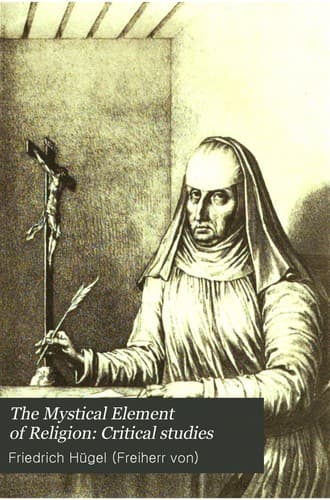
The Mystical Element of Religion, as studied in Saint Catherine of Genoa and her friends, Volume 2 (of 2)Hügel, Friedrich, Freiherr von
Religion
The Mystical Element of Religion, as studied in Saint Catherine of Genoa and her friends, Volume 2 (of 2)
Hügel, Friedrich, Freiherr von
Catherine, of Genoa, Saint, 1447-1510
(2) Again, as to Triads, it is interesting to note that Catherine has
nothing about the three stages or ways of the inner life,--purgative,
illuminative, unitive,--of which Dionysius is full, and which are
already indicated in Proclus; for we can find but two in her life, the
purgative and unitive, and in her teaching these two alone appear,
mostly in close combination, sometimes in strong contrast. Nor has
she anything about the three degrees or kinds of prayer,--Meditation,
Contemplation, Union,--as indicated in Dionysius: “It behoves us, by
our prayers, to be lifted into proximity with the Divine Trinity; and
then, by still further approaching it, to be initiated…; and (lastly)
to make ourselves one with it”; and as taught by Proclus: “Knowledge
leads, then follows proximity, and then union.”[102] With her we
only get Contemplation and Union.--Nor do we get in her anything
about thrice three choirs of Angels, or three orders of Christian
Ministrants, or three classes of Christian people, or thrice three
groups of Sacraments and Sacramental acts. For she is too intensely
bent upon immediate intercourse with God, and too much absorbed in the
sense of profound unity and again of innumerable multiplicity, to be
attracted by Dionysius’s Neo-Platonist ladder of carefully graduated
intermediaries, or by his continuous interest in triads of every kind.
Catherine thus follows the current in Dionysius which insists upon
direct contact between the soul and the transcendent God, and ignores
the other, which bridges over the abyss between the two by carefully
graduated intermediaries: these intermediaries having become, with her,
successive stages of purification and of ever more penetrating union of
the one soul with the one God.
5. _Deification, especially through the Eucharist._
As to the end of the whole process, we find that Deification, so
frequently implied or suggested by Catherine, is formally taught by
Dionysius: “A union of the deified minds” (ἐκθεουμένων); the heavenly
and the earthly Hierarchy have the power and task “to communicate
to their subjects, according to the dignity of each, the sacred
deification” (ἐκθέωσις); “we are led up, by means of the multiform of
sensible symbols, to the uniform Deification.”[103] “The One is the
very God,” says Proclus, “but the Mind (the Noûs) is the divinest of
beings, and the soul is divine, and the body is godlike.… And every
body that is God-like is so through the soul having become divine; and
every soul that is divine, is so through the Mind being very divine;
and every Mind that is thus very divine, is so through participation
in the Divine One.”[104] There are preformations of this doctrine in
Plotinus and echoes of it throughout Catherine’s sayings.
Public-domain text, read in full here on John Shaqi.
Reviews
Reviews
No reviews yet
Be the first to share your thoughts on this work.
Elsewhere in the archive
Join the Discussion
Join the discussion
Sign in to leave a comment or review.
Sign InorCreate an account