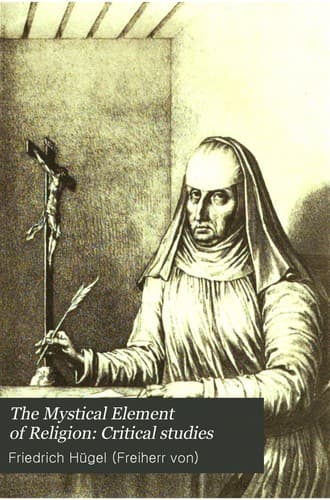
The Mystical Element of Religion, as studied in Saint Catherine of Genoa and her friends, Volume 2 (of 2)Hügel, Friedrich, Freiherr von
Religion
The Mystical Element of Religion, as studied in Saint Catherine of Genoa and her friends, Volume 2 (of 2)
Hügel, Friedrich, Freiherr von
Catherine, of Genoa, Saint, 1447-1510
In the case of Jacopone, the suddenly wife-bereft and converted lawyer,
an ardent poet doubled by a soaring, daring mystic, with an astonishing
richness of simultaneous symbols and conceptions and rapidity of
successive complements and contrasts, it will really be simplest if
I take the chief touches which have characteristically stimulated
Catherine or have left her unaffected, in the order and grouping in
which they appear in his chief “Lode,” as these latter are given in the
first printed edition, probably the very one used by Catherine.[109]
1. _Lode XIII, XXIII, XXXV, XLV._
In Loda XIII “the vicious soul is likened unto Hell,” vv. 1-7; and “the
soul that yesterday was Hell, to-day has turned into Heaven,” v. 8. We
thus get here, precisely as in Catherine, the spaceless conditions of
the soul and their modifications treated under the symbols of places
and of the spacial change from one place to the other.
In Loda XXIII we first have five successive purifications and purities
of Love, “carnal, counterfeit, self-seeking, natural, spiritual,
transformed,” vv. 1-6; and then the symbols of spacial location
and movement reappear, “if height does not abase itself, it cannot
participate with, nor communicate itself to, the lowest grade”; all
which is frequent with Catherine. But she nowhere echoes the teaching
reproduced here, v. 10, as to the Divine Trinity being figured in man’s
three faculties of soul.
Loda XXXV gives us a sort of Christian Stoicism very dear dear to
Catherine: “Thou, my soul, hast been created in great elevation; thy
nature is grounded in great nobility (_gentilezza_),” v. 7; “thou hast
not thy life in created things; it is necessary for thee to breathe in
other countries, to mount up to God thine inheritance, Who (alone) can
satisfy thy poverty,” v. 10; “great is the honour which thou doest to
God, when thou abidest (stare) in Him, in thy (true) nobility,” v. 11.
Loda XLV gives “the Five Modes in which God appears in the Soul”--“the
state of fear”; mercenary, “beggar-love”; “the way of love”; “the
paternal mode”; “the mode of espousals.” Catherine leaves the last two,
anthropomorphic and familial, conceptions quite unused, and passes in
her life, at one bound, from the first to the third mode.
2. _Lode LVIIIa, LVIIIb._
Public-domain text, read in full here on John Shaqi.
Reviews
Reviews
No reviews yet
Be the first to share your thoughts on this work.
Elsewhere in the archive
Join the Discussion
Join the discussion
Sign in to leave a comment or review.
Sign InorCreate an account