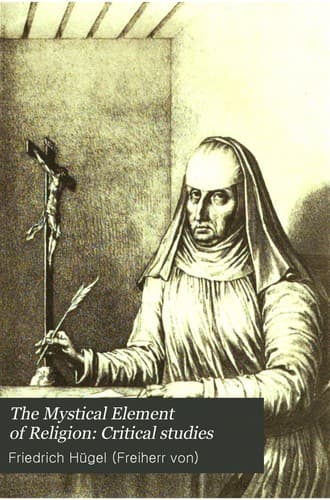
The Mystical Element of Religion, as studied in Saint Catherine of Genoa and her friends, Volume 2 (of 2)Hügel, Friedrich, Freiherr von
Religion
The Mystical Element of Religion, as studied in Saint Catherine of Genoa and her friends, Volume 2 (of 2)
Hügel, Friedrich, Freiherr von
Catherine, of Genoa, Saint, 1447-1510
Verses 10 to 30 describe the three heavens of successive
self-despoilments. The firmamental heaven, which typifies the four-fold
renouncement,--of honour, riches, science, reputation of sanctity,
has left no echo in Catherine. The stellar heaven is “composed of
solidified clear waters (_aque solidate_)”; here “the four winds”
cease “that move the sea,--that perturb the mind: fear and hope, grief
and joy,” 11-14. Here Plato again touches Catherine through Jacopone.
For the _Symposium_, 197_a_, declares: “Love it is that produces
peace among men and calm on the sea, a cessation of the winds, and
repose and sleep even in trouble”; and Jacopone identifies the middle
“crystalline” heaven, (“the waters above” of Genesis, chap, i,) with
Plato’s “sea”; takes Plato’s (four) winds as the soul’s chief passions;
and considers Plato’s “peace” and “windlessness” as equivalent to the
“much silence,” which, says the Apocalypse, “arose in heaven,” viii, 1,
interpreted here as “in mid-heaven.” “Not to fear Hell, nor to hope for
Heaven, to rejoice in no good, to grieve over no adversity,” v. 16, is
a formulation unlike Catherine, although single sayings of hers stand
for sentiments analogous to the first and last.--“If the virtues are
naked, and the vices are not garmented,--mortal wounds get given to the
soul,” v. 19, has a symbolism exactly opposite to Catherine’s, who, we
know, loves to glorify “nakedness” as the soul’s purity.--“The highest
heaven” is “beyond even the imagings of the mortified fancy”; “of every
good it has despoiled thee, and has expropriated thee from all virtue:
lay up as a treasure this thy gain,--the sense of thine own vileness.”
“O purified Love! it alone lives in the truth!” These verses, 20-22,
have left a deep impress upon Catherine, although she wisely does
not press that “expropriation from virtue,” which goes back at least
to Plotinus, for whom the true Ecstatic is “beyond the choir of the
virtues.”[110]
“That which appears to thee (as extant), is not truly, existent:
so high (above) is that which truly is. True elevation of soul
(_la superbia_) dwells in heaven above, and baseness of mind
(_humilitade_) leads to damnation,” v. 24, is a saying to which we
still have Catherine’s detailed commentary. In its markedly Platonic
distinction between an upper true and a lower seeming world, and in its
characteristically mystical love of paradox and a play upon words, it
is more curious than abidingly important; but in its deeply Christian
consciousness of “pride” and “humility,” in their ordinary ethical
sense, being respectively the subtlest vice and the noblest virtue, it
rises sheer above all Platonist and Neo-Platonist apprehension.
Public-domain text, read in full here on John Shaqi.
Reviews
Reviews
No reviews yet
Be the first to share your thoughts on this work.
Elsewhere in the archive
Join the Discussion
Join the discussion
Sign in to leave a comment or review.
Sign InorCreate an account