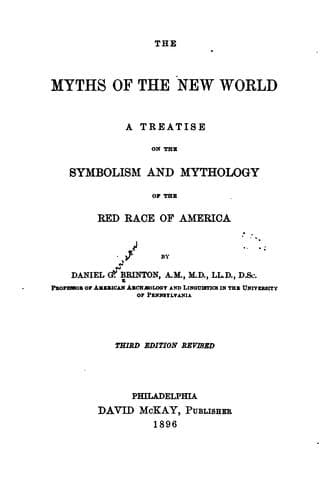
The Myths of the New World: A Treatise on the Symbolism and Mythology of the Red Race of AmericaBrinton, Daniel G. (Daniel Garrison)
Religion
The Myths of the New World: A Treatise on the Symbolism and Mythology of the Red Race of America
Brinton, Daniel G. (Daniel Garrison)
Indian mythology; Indians -- Folklore
The intimate connection that once existed between the myths of the
deluge and those of the creation is illustrated by the part assigned to
birds in so many of them. They fly to and fro over the waves ere any
land appears, though they lose in great measure the significance of
bringing it forth, attached to them in the cosmogonies as emblems of the
divine spirit. The dove in the Hebrew account appears in that of the
Algonkins as a raven, which Michabo sent out to search for land before
the muskrat brought it to him from the bottom. A raven also in the
Athapascan myth saved their ancestors from the general flood, and in
this instance it is distinctly identified with the mighty thunder bird,
who at the beginning ordered the earth from the depths. Prometheus-like,
it brought fire from heaven, and saved them from a second death by
cold.[205-1] Precisely the same beneficent actions were attributed by
the Natchez to the small red cardinal bird,[205-2] and by the Mandans
and Cherokees an active participation in the event was assigned to wild
pigeons. The Navajos and Aztecs thought that instead of being drowned by
the waters the human race were transformed into birds and thus escaped.
In all these and similar legends, the bird is a relic of the cosmogonal
myth which explained the origin of the world from the action of the
winds, under the image of the bird, on the primeval ocean.
The Mexican Codex Vaticanus No. 3738 represents after the picture of the
deluge a bird perched on the summit of a tree, and at its foot men in
the act of marching. This has been interpreted to mean that after the
deluge men were dumb until a dove distributed to them the gift of
speech. The New Mexican tribes related that all except the leader of
those who escaped to the mountains lost the power of utterance by
terror,[205-3] and the Quichés that the antediluvian race were "puppets,
men of wood, without intelligence or language." These stories, so
closely resembling that of the confusion of tongues at the tower of
Babel or Borsippa, are of doubtful authenticity. The first is an
entirely erroneous interpretation, as has been shown by Señor Ramirez,
director of the Museum of Antiquities at Mexico. The name of the bird in
the Aztec tongue was identical with the word _departure_, and this is
its signification in the painting.[206-1]
Stories of giants in the days of old, figures of mighty proportions
looming up through the mist of ages, are common property to every
nation. The Mexicans and Peruvians had them as well as others, but their
connection with the legends of the flood and the creation is incidental
and secondary. Were the case otherwise, it would offer no additional
point of similarity to the Hebrew myth, for the word rendered _giants_
in the phrase, "and there were giants in those days," has no such
meaning in the original. It is a blunder which crept into the
Septuagint, and has been cherished ever since, along with so many others
in the received text.
Public-domain text, read in full here on John Shaqi.
Reviews
Reviews
No reviews yet
Be the first to share your thoughts on this work.
Elsewhere in the archive
Join the Discussion
Join the discussion
Sign in to leave a comment or review.
Sign InorCreate an account