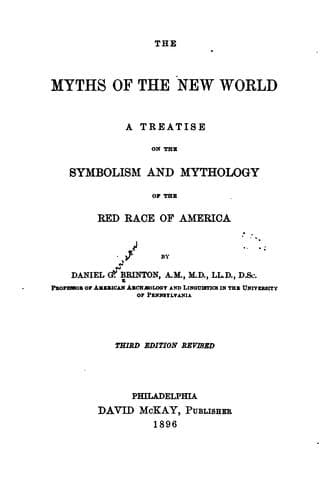
The Myths of the New World: A Treatise on the Symbolism and Mythology of the Red Race of AmericaBrinton, Daniel G. (Daniel Garrison)
Religion
The Myths of the New World: A Treatise on the Symbolism and Mythology of the Red Race of America
Brinton, Daniel G. (Daniel Garrison)
Indian mythology; Indians -- Folklore
"And this is what the dogs said, 'Why did you not give us our food? No
sooner did we come near than you drove us away, and the stick was always
within reach when you were eating, because, forsooth, we were not able
to talk. Now we will use our teeth and eat you,' said the dogs, tearing
their faces.
"And the cups and dishes said, 'Pain and misery you gave us, smoking our
tops and sides, cooking us over the fire, burning and hurting us as if
we had no feeling.[209-1] Now it is your turn, and you shall burn,' said
the cups insultingly.
"Then ran the men hither and thither in despair. They climbed to the
roofs of the houses, but the houses crumbled under their feet; they
tried to mount to the tops of the trees, but the trees hurled them far
from them; they sought refuge in the caverns, but the caverns shut
before them.
"Thus was accomplished the ruin of this race, destined to be destroyed
and overthrown; thus were they given over to destruction and contempt.
And it is said that their posterity are those little monkeys who live in
the woods."[209-2]
The Algonkin tradition has often been referred to. Many versions of it
are extant, the oldest and most authentic of which is that translated
from the Montagnais dialect by Father le Jeune, in 1634.
"One day as Messou was hunting, the wolves which he used as dogs entered
a great lake and were detained there.
"Messou looking for them everywhere, a bird said to him, 'I see them in
the middle of this lake.'
"He entered the lake to rescue them, but the lake overflowing its banks
covered the land and destroyed the world.
"Messou, very much astonished at this, sent out the raven to find a
piece of earth wherewith to rebuild the land, but the bird could find
none; then he ordered the otter to dive for some, but the animal
returned empty; at last he sent down the muskrat, who came back with
ever so small a piece, which, however, was enough for Messou to form the
land on which we are.
"The trees having lost their branches, he shot arrows at their naked
trunks which became their limbs, revenged himself on those who had
detained his wolves, and having married the muskrat, by it peopled the
world."
Finally may be given the meagre legend of the Tupis of Brazil, as heard
by Hans Staden, a prisoner among them about 1550, and Coreal, a later
voyager. Their ancient songs relate that a long time ago a certain very
powerful Mair, that is to say, a stranger, who bitterly hated their
ancestors, compassed their destruction by a violent inundation. Only a
very few succeeded in escaping--some by climbing trees, others in caves.
When the waters subsided the remnant came together, and by gradual
increase populated the world.[210-1]
Or, it is given by an equally ancient authority as follows:--
Public-domain text, read in full here on John Shaqi.
Reviews
Reviews
No reviews yet
Be the first to share your thoughts on this work.
Elsewhere in the archive
Join the Discussion
Join the discussion
Sign in to leave a comment or review.
Sign InorCreate an account