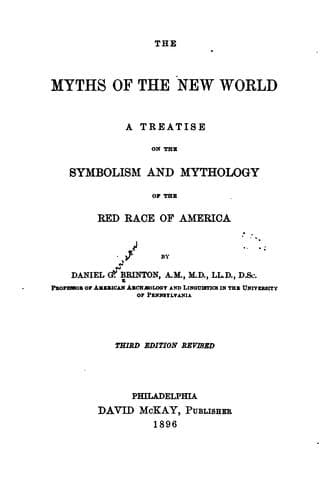
The Myths of the New World: A Treatise on the Symbolism and Mythology of the Red Race of AmericaBrinton, Daniel G. (Daniel Garrison)
Religion
The Myths of the New World: A Treatise on the Symbolism and Mythology of the Red Race of America
Brinton, Daniel G. (Daniel Garrison)
Indian mythology; Indians -- Folklore
CHAPTER VIII.
THE ORIGIN OF MAN.
Usually man is the EARTH-BORN, both in language and
myths.--Illustrations from the legends of the Caribs, Apalachians,
Iroquois, Quichuas, Aztecs, and others.--The underworld.--Man the
product of one of the primal creative powers, the Spirit, or the
Water, in the myths of the Athapascas, Eskimos, Moxos, and
others.--Never literally derived from an inferior species.
No man can escape the importunate question, whence am I? The first
replies framed to meet it possess an interest to the thoughtful mind,
beyond that of mere fables. They illustrate the position in creation
claimed by our race, and the early workings of self-consciousness. Often
the oldest terms for man are synopses of these replies, and merit a more
than passing contemplation.
The seed is hidden in the earth. Warmed by the sun, watered by the rain,
presently it bursts its dark prison-house, unfolds its delicate leaves,
blossoms, and matures its fruit. Its work done, the earth draws it to
itself again, resolves the various structures into their original mould,
and the unending round recommences.
This is the marvellous process that struck the primitive mind. Out of
the Earth rises life, to it it returns. She it is who guards all germs,
nourishes all beings. The Aztecs painted her as a woman with countless
breasts, the Peruvians called her Mama Allpa, _mother_ Earth. _Homo_,
_Adam_, _chamaigenēs_, what do all these words mean but the
earth-born, the son of the soil, repeated in the poetic language of
Attica in _anthropos_, he who springs up as a flower?
The word that corresponds to the Latin _homo_ in American languages has
such singular uniformity in so many of them, that we might be tempted to
regard it as a fragment of some ancient and common tongue, their parent
stem. In the Eskimo it is _inuk_, _innuk_, plural _innuit_; in Athapasca
it is _dinni_, _tenné_; in Algonkin, _inini_, _lenni_, _inwi_; in
Iroquois, _onwi_, _eniha_; in the Otomi of Mexico _n-aniehe_; in the
Maya, _inic_, _winic_, _winak_; all in North America, and the number
might be extended. Of these only the last mentioned can plausibly be
traced to a radical (unless the Iroquois _onwi_ is from _onnha_ life,
_onnhe_ to live). This Father Ximenes derives from _win_, meaning to
grow, to gain, to increase,[223-1] in which the analogy to vegetable
life is not far off, an analogy strengthened by the myth of that stock,
which relates that the first of men were formed of the flour of
maize.[223-2]
Public-domain text, read in full here on John Shaqi.
Reviews
Reviews
No reviews yet
Be the first to share your thoughts on this work.
Elsewhere in the archive
Join the Discussion
Join the discussion
Sign in to leave a comment or review.
Sign InorCreate an account