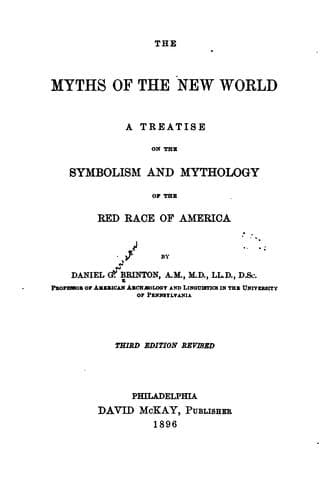
The Myths of the New World: A Treatise on the Symbolism and Mythology of the Red Race of AmericaBrinton, Daniel G. (Daniel Garrison)
Religion
The Myths of the New World: A Treatise on the Symbolism and Mythology of the Red Race of America
Brinton, Daniel G. (Daniel Garrison)
Indian mythology; Indians -- Folklore
In their own languages they are variously called; by the Algonkins and
Dakotas, "those knowing divine things" and "dreamers of the gods"
(_manitousiou_, _wakanwacipi_); in Mexico, "masters or guardians of the
divine things" (_teopixqui_, _teotecuhtli_); in Cherokee, their title
means, "possessed of the divine fire" (_atsilung kelawhi_); in Iroquois,
"keepers of the faith" (_honundeunt_); in Quichua, "the learned"
(_amauta_); in Maya, "the listeners" (_cocome_). The popular term in
French and English of "medicine men" is not such a misnomer as might be
supposed. The noble science of medicine is connected with divinity not
only by the rudest savage but the profoundest philosopher, as has been
already adverted to. When sickness is looked upon as the effect of the
anger of a god, or as the malicious infliction of a sorcerer, it is
natural to seek help from those who assume to control the unseen world,
and influence the fiats of the Almighty. The recovery from disease is
the kindliest exhibition of divine power. Therefore the earliest canons
of medicine in India and Egypt are attributed to no less distinguished
authors than the gods Brahma and Thoth;[265-1] therefore the earliest
practitioners of the healing art are universally the ministers of
religion.
But, however creditable this origin is to medicine, its partnership with
theology was no particular advantage to it. These mystical doctors
shared the contempt still so prevalent among ourselves for a treatment
based on experiment and reason, and regarded the administration of
emetics and purgatives, baths and diuretics, with a contempt quite equal
to that of the disciples of Hahnemann. The practitioners of the rational
school formed a separate class among the Indians, and had nothing to do
with amulets, powwows, or spirits.[265-2] They were of different name
and standing, and though held in less estimation, such valuable
additions to the pharmacopœia as guaiacum, cinchona, and ipecacuanha,
were learned from them. The priesthood scorned such ignoble means. Were
they summoned to a patient, they drowned his groans in a barbarous
clangor of instruments in order to fright away the demon that possessed
him; they sucked and blew upon the diseased organ, they sprinkled him
with water, and catching it again threw it on the ground, thus drowning
out the disease; they rubbed the part with their hands, and exhibiting a
bone or splinter asserted that they drew it from the body, and that it
had been the cause of the malady, they manufactured a little image to
represent the spirit of sickness, and spitefully knocked it to pieces,
thus vicariously destroying its prototype; they sang doleful and
monotonous chants at the top of their voices, screwed their
countenances into hideous grimaces, twisted their bodies into unheard of
contortions, and by all accounts did their utmost to merit the
honorarium they demanded for their services. A double motive spurred
them to spare no pains.
Public-domain text, read in full here on John Shaqi.
Reviews
Reviews
No reviews yet
Be the first to share your thoughts on this work.
Elsewhere in the archive
Join the Discussion
Join the discussion
Sign in to leave a comment or review.
Sign InorCreate an account