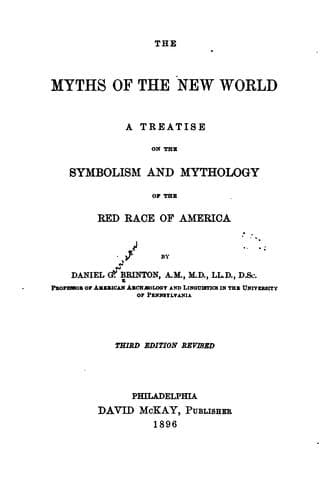
The Myths of the New World: A Treatise on the Symbolism and Mythology of the Red Race of AmericaBrinton, Daniel G. (Daniel Garrison)
Religion
The Myths of the New World: A Treatise on the Symbolism and Mythology of the Red Race of America
Brinton, Daniel G. (Daniel Garrison)
Indian mythology; Indians -- Folklore
All these stratagems were intended to shroud with impenetrable secrecy
the mysteries of the brotherhood. With the same motive, the priests
formed societies of different grades of illumination, only to be entered
by those willing to undergo trying ordeals, whose secrets were not to be
revealed under the severest penalties. The Algonkins had three such
grades, the _waubeno_, the _meda_, and the _jossakeed_, the last being
the highest. To this no white man was ever admitted. All tribes appear
to have been controlled by these secret societies. Alexander von
Humboldt mentions one, called that of the Botuto or Holy Trumpet, among
the Indians of the Orinoko, whose members must vow celibacy and submit
to severe scourgings and fasts. The Collahuayas of Peru were a guild of
itinerant quacks and magicians, who never remained permanently in one
spot.
Withal, there was no class of persons who so widely and deeply
influenced the culture and shaped the destiny of the Indian tribes, as
their priests. In attempting to gain a true conception of the race's
capacities and history, there is no one element of their social life
which demands closer attention than the power of these teachers.
Hitherto, they have been spoken of with a contempt which I hope this
chapter shows is unjustifiable. However much we may deplore the use they
made of their skill, we must estimate it fairly, and grant it its due
weight in measuring the influence of the religious sentiment on the
history of man.
FOOTNOTES:
[265-1] Haeser, _Geschichte der Medicin_, pp. 4, 7: Jena, 1845.
[265-2] Schoolcraft, _Ind. Tribes_, v. p. 440.
[267-1] Carver, _Travels in North America_, p. 73: Boston, 1802;
_Narrative of John Tanner_, p. 135.
[267-2] Sahagun, _Hist. de la Nueva España_, lib. x. cap. 20; _Le Livre
Sacré des Quichés_, p. 177; _Lett. sur les Superstit. du Pérou_, pp. 89,
91.
[269-1] _Life of Black Hawk_, p. 13.
[270-1] _Travs. in North America_, p. 74.
[270-2] _Journal Historique_, p. 362.
[271-1] Sometimes facts like this can be explained by the quickness of
perception acquired by constant exposure to danger. The mind takes
cognizance unconsciously of trifling incidents, the sum of which leads it
to a conviction which the individual regards almost as an inspiration.
This is the explanation of _presentiments_. But this does not apply to
cases like that of Swedenborg, who described a conflagration going on at
Stockholm, when he was at Gottenberg, three hundred miles away.
Psychologists who scorn any method of studying the mind but through
physiology, are at a loss in such cases, and take refuge in refusing them
credence. Theologians call them inspirations either of devils or angels,
as they happen to agree or disagree in religious views with the person
experiencing them. True science reserves its opinion until further
observation enlightens it.
[272-1] Schoolcraft, _Indian Tribes_, iii. p. 287; v. p. 652.
Public-domain text, read in full here on John Shaqi.
Reviews
Reviews
No reviews yet
Be the first to share your thoughts on this work.
Elsewhere in the archive
Join the Discussion
Join the discussion
Sign in to leave a comment or review.
Sign InorCreate an account