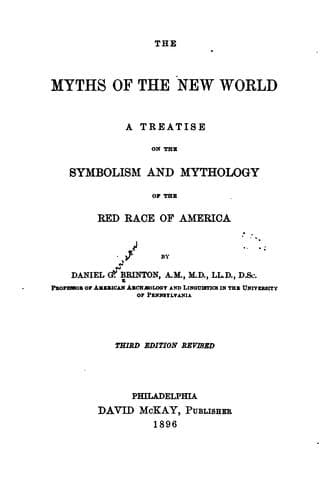
The Myths of the New World: A Treatise on the Symbolism and Mythology of the Red Race of AmericaBrinton, Daniel G. (Daniel Garrison)
Religion
The Myths of the New World: A Treatise on the Symbolism and Mythology of the Red Race of America
Brinton, Daniel G. (Daniel Garrison)
Indian mythology; Indians -- Folklore
Drawing toward the conclusion of my essay, I I am sensible that the vast
field of American mythology remains for most part untouched--that I have
but proved that it is not an absolute wilderness, pathless as the
tropical jungles which now conceal the temples of the race; but that, go
where we will, certain landmarks and guide-posts are visible, revealing
uniformity of design and purpose, and refuting, by their presence, the
oft-repeated charge of entire incoherence and aimlessness. It remains to
examine the subjective power of the native religions, their influence on
those who held them, and the place they deserve in the history of the
race. What are their merits, if merits they have? what their demerits?
Did they purify the life and enlighten the mind, or the contrary? Are
they in short of evil or of good? The problem is complex--its solution
most difficult. The author who of late years has studied most profoundly
the savage races of the globe, expresses the discouraging conviction:
"Their religions have not acted as levers to raise them to
civilization; they have rather worked, and that powerfully, to impede
every step in advance, in the first place by ascribing everything
unintelligible in nature to spiritual agency, and then by making the
fate of man dependent on mysterious and capricious forces, not on his
own skill and foresight."[288-1]
It would ill accord with the theory of mythology which I have all along
maintained if this verdict were final. But in fact these false doctrines
brought with them their own antidotes, at least to some extent, and
while we give full weight to their evil, let us also acknowledge their
good. By substituting direct divine interference for law, belief for
knowledge, a dogma for a fact, the highest stimulus to mental endeavor
was taken away. Nature, to the heathen, is no harmonious whole swayed by
eternal principles, but a chaos of causeless effects, the meaningless
play of capricious ghosts. He investigates not, because he doubts not.
All events are to him miracles. Therefore his faith knows no bounds, and
those who teach that doubt is sinful must contemplate him with
admiration. The damsels of Nicaragua destined to be thrown into the
seething craters of volcanoes, went to their fate, says Pascual de
Andagoya, "happy as if they were going to be saved,"[288-2] and
doubtless believing so. The subjects of a Central American chieftain,
remarks Oviedo, "look upon it as the crown of favors to be permitted to
die with their cacique, and thus to acquire immortality."[288-3] The
terrible power exerted by the priests rested, as they themselves often
saw, largely on the implicit and literal acceptance of their dicta.
In some respects the contrast here offered to enlightened nations is not
always in favor of the latter. Borrowing the pointed antithesis of the
poet, the mind is often tempted to exclaim--
Public-domain text, read in full here on John Shaqi.
Reviews
Reviews
No reviews yet
Be the first to share your thoughts on this work.
Elsewhere in the archive
Join the Discussion
Join the discussion
Sign in to leave a comment or review.
Sign InorCreate an account