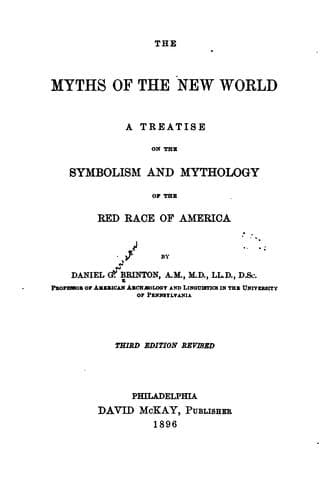
The Myths of the New World: A Treatise on the Symbolism and Mythology of the Red Race of AmericaBrinton, Daniel G. (Daniel Garrison)
Religion
The Myths of the New World: A Treatise on the Symbolism and Mythology of the Red Race of America
Brinton, Daniel G. (Daniel Garrison)
Indian mythology; Indians -- Folklore
Looking around for other standards wherewith to measure the progress of
the knowledge of divinity in the New World, _prayer_ suggests itself as
one of the least deceptive. "Prayer," to quote again the words of
Novalis,[296-2] "is in religion what thought is in philosophy. The
religious sense prays, as the reason thinks." Guizot, carrying the
analysis farther, thinks that it is prompted by a painful conviction of
the inability of our will to conform to the dictates of reason.[296-3]
Originally it was connected with the belief that divine caprice, not
divine law, governs the universe, and that material benefits rather than
spiritual gifts are to be desired. The gradual recognition of its
limitations and proper objects marks religious advancement. The Lord's
Prayer contains seven petitions, only one of which is for a temporal
advantage, and it the least that can be asked for. What immeasurable
interval between it and the prayer of the Nootka Indian on preparing for
war!--
"Great Quahootze, let me live, not be sick, find the enemy, not fear
him, find him asleep, and kill a great many of him."[297-1]
Or again, between it and the petition of a Huron to a local god, heard
by Father Brebeuf:--
"Oki, thou who livest in this spot, I offer thee tobacco. Help us, save
us from shipwreck, defend us from our enemies, give us a good trade, and
bring us back safe and sound to our villages."[297-2]
This is a fair specimen of the supplications of the lowest religion.
Another equally authentic is given by Father Allouez.[297-3] In 1670 he
penetrated to an outlying Algonkin village, never before visited by a
white man. The inhabitants, startled by his pale face and long black
gown, took him for a divinity. They invited him to the council lodge, a
circle of old men gathered around him, and one of them, approaching him
with a double handful of tobacco, thus addressed him, the others
grunting approval:--
"This, indeed, is well, Blackrobe, that thou dost visit us. Have mercy
upon us. Thou art a Manito. We give thee to smoke.
"The Naudowessies and Iroquois are devouring us. Have mercy upon us.
"We are often sick; our children die; we are hungry. Have mercy upon us.
Hear me, O Manito, I give thee to smoke.
"Let the earth yield us corn; the rivers give us fish; sickness not slay
us; nor hunger so torment us. Hear us, O Manito, we give thee to smoke."
In this rude but touching petition, wrung from the heart of a miserable
people, nothing but their wretchedness is visible. Not the faintest
trace of an aspiration for spiritual enlightenment cheers the eye of the
philanthropist, not the remotest conception that through suffering we
are purified can be detected.
Public-domain text, read in full here on John Shaqi.
Reviews
Reviews
No reviews yet
Be the first to share your thoughts on this work.
Elsewhere in the archive
Join the Discussion
Join the discussion
Sign in to leave a comment or review.
Sign InorCreate an account