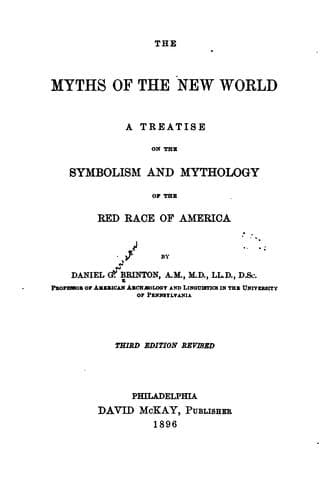
The Myths of the New World: A Treatise on the Symbolism and Mythology of the Red Race of AmericaBrinton, Daniel G. (Daniel Garrison)
Religion
The Myths of the New World: A Treatise on the Symbolism and Mythology of the Red Race of America
Brinton, Daniel G. (Daniel Garrison)
Indian mythology; Indians -- Folklore
is a harmonious whole, the soul of which is God; numbers, figures, the
stars, all nature, indeed, are in unison with the mysteries of
religion"?
FOOTNOTES:
[67-1] Buckingham Smith, _Gram. Notices of the Heve Language_, p. 26
(Shea's Lib. Am. Linguistics).
[68-1] I refer to thefour "ultimate elementary particles" of Empedocles. The number was
sacred to Hermes, and lay at the root of the physical philosophy of
Pythagoras. The quotation in the text is from the "Golden Verses," given
in Passow's lexicon under the word τετρακτὺς: ναι μα τον ἁμετερᾳ ψυχᾳ
παραδοντα τετρακτυν, παγαν αεναου φυσεως. "The most sacred of all
things," said this famous teacher, "is Number; and next to it, that
which gives Names;" a truth that the lapse of three thousand years is
just enabling us to appreciate.
[68-2] Ximenes, _Or. de los Indios_, etc., p. 5.
[68-3] See Sepp, _Heidenthum und dessen Bedeutung für das Christenthum_,
i. p. 464 sqq., a work full of learning, but written in the wildest vein
of Joseph de Maistre's school of Romanizing mythology.
[69-1] Brasseur, _Hist. du Mexique_, ii. p. 227, _Le Livre Sacré des
Quichés_, introd. p. ccxlii. The four provinces of Peru were Anti, Cunti,
Chincha, and Colla. The meaning of these names has been lost, but to
repeat them, says La Vega, was the same as to use our words, east, west,
north, and south (_Hist. des Incas_, lib. ii. cap. 11).
[69-2] Humboldt, _Polit. Essay on New Spain_, ii. p. 44.
[70-1] This custom has been often mentioned among the Iroquois.
Algonkins, Dakotas, Creeks, Natchez, Araucanians, and other tribes.
Nuttall points out its recurrence among the Tartars of Siberia also.
(_Travels_, p. 175.)
[71-1] Schoolcraft, _Indian Tribes_, v. pp. 424 et seq.
[71-2] _Letters on the North American Indians_, vol. i., Letter 22.
[71-3] Schoolcraft, _Indian Tribes_, iv. p. 643 sq. "Four is their sacred
number," says Mr. Pond (p. 646). Their neighbors, the Pawnees, though not
the most remote affinity can be detected between their languages,
coincide with them in this sacred number, and distinctly identified it
with the cardinal points. See De Smet, _Oregon Missions_, pp. 360, 361.
[72-1] Benj. Hawkins, _Sketch of the Creek Country_, pp. 75, 78:
Savannah, 1848. The description he gives of the ceremonies of the Creeks
was transcribed word for word and published in the first volume of the
American Antiquarian Society's Transactions as of the Shawnees of Ohio.
This literary theft has not before been noticed.
[72-2] Palacios, _Des. de la Prov. de Guatemala_, pp. 31, 32, ed.
Ternaux-Compans.
Public-domain text, read in full here on John Shaqi.
Reviews
Reviews
No reviews yet
Be the first to share your thoughts on this work.
Join the Discussion
Join the discussion
Sign in to leave a comment or review.
Sign InorCreate an account