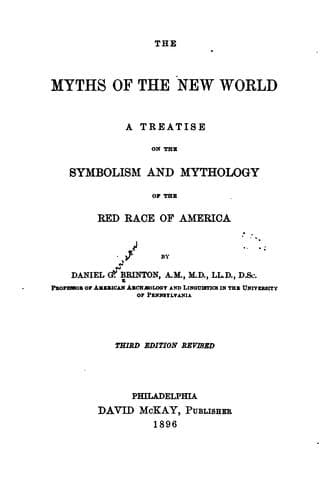
The Myths of the New World: A Treatise on the Symbolism and Mythology of the Red Race of AmericaBrinton, Daniel G. (Daniel Garrison)
Religion
The Myths of the New World: A Treatise on the Symbolism and Mythology of the Red Race of America
Brinton, Daniel G. (Daniel Garrison)
Indian mythology; Indians -- Folklore
[73-1] All familiar with Mexican antiquity will recall many such
examples. I may particularly refer to Kingsborough, _Antiqs. of Mexico_,
v. p. 480, Ternaux-Compans' _Recueil de pièces rel. à la Conq. du
Mexique_, pp. 307, 310, and Gama, _Des. de las dos Piedras que se
hallaron en la plaza principal de Mexico_, ii. sec. 126 (Mexico, 1832),
who gives numerous instances beyond those I have cited, and directs with
emphasis the attention of the reader to this constant repetition.
[74-1] Albert Gallatin, _Trans. Am. Ethnol. Soc._, ii. p. 316, from the
Codex Vaticanus, No. 3738.
[75-1] Riggs, _Gram. and Dict. of the Dakota Lang._, s. v.
[75-2] Sahagun, _Hist. de la Nueva España_, in Kingsborough, v. p. 375.
[76-1] Egede, _Nachrichten von Grönland_, pp. 137, 173, 285. (Kopenhagen,
1790.)
[77-1] Schoolcraft, _Algic Researches_, i. p. 139, and _Indian Tribes_,
iv. p. 229.
[78-1] Hawkins, _Sketch of the Creek Country_, pp. 81, 82, and Blomes,
_Acc. of his Majesty's Colonies_, p. 156, London, 1687, in Castiglioni,
_Viaggi nelle Stati Uniti_, i. p. 294.
[78-2] Peter Martyr, _De Reb. Ocean._, Dec. i. lib. ix. The story is also
told more at length by the Brother Romain Pane, in the essay on the
ancient histories of the natives he drew up by the order of Columbus. It
has been reprinted with notes by the Abbé Brasseur, Paris, 1864, p. 438
sqq.
[79-1] Schoolcraft, _Ind. Tribes_, iv. p. 89.
[79-2] Brasseur, _Le Liv. Sac._, Introd., p. cxvii.
[80-1] Diego de Landa, _Rel. de las Cosas de Yucatan_, pp. 160, 206, 208,
ed. Brasseur. The learned editor, in a note to p. 208, states erroneously
the disposition of the colors, as may be seen by comparing the document
on p. 395. This dedication of colors to the cardinal points is universal
in Central Asia. The geographical names of the Red Sea, the Black Sea,
the Yellow Sea or Persian Gulf, and the White Sea or the Mediterranean,
are derived from this association. The cities of China, many of them at
least, have their gates which open toward the cardinal points painted of
certain colors, and precisely these four, the white, the black, the red,
and the yellow, are those which in Oriental myth the mountain in the
centre of Paradise shows to the different cardinal points. (Sepp,
_Heidenthum und Christenthum_, i. p. 177.) The coincidence furnishes food
for reflection.
[81-1] _Le Livre Sacré des Quichés_, pp. 203-5, note.
[82-1] The analogy is remarkable between these and the "quatre actes de
la puissance generatrice jusqu'à l'entier developpément des corps
organisés," portrayed by four globes in the Mycenean bas-reliefs. See
Guigniaut, _Religions de l'Antiquité_, i. p. 374. It were easy to
multiply the instances of such parallelism in the growth of religious
thought in the Old and New World, but I designedly refrain from doing so.
They have already given rise to false theories enough, and moreover my
purpose in this work is not "comparative mythology."
Public-domain text, read in full here on John Shaqi.
Reviews
Reviews
No reviews yet
Be the first to share your thoughts on this work.
Join the Discussion
Join the discussion
Sign in to leave a comment or review.
Sign InorCreate an account