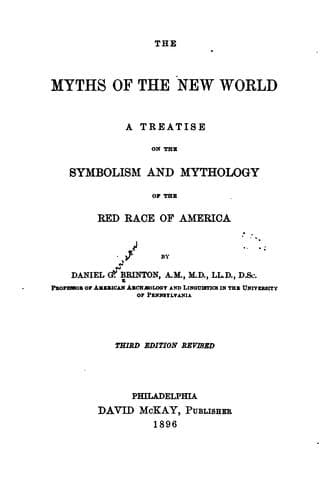
The Myths of the New World: A Treatise on the Symbolism and Mythology of the Red Race of AmericaBrinton, Daniel G. (Daniel Garrison)
Religion
The Myths of the New World: A Treatise on the Symbolism and Mythology of the Red Race of America
Brinton, Daniel G. (Daniel Garrison)
Indian mythology; Indians -- Folklore
Beyond all others, two subdivisions of the animal kingdom have so
riveted the attention of men by their unusual powers, and enter so
frequently into the myths of every nation of the globe, that a right
understanding of their symbolic value is an essential preliminary to the
discussion of the divine legends. They are the BIRD and the SERPENT. We
shall not go amiss if we seek the reasons of their pre-eminence in the
facility with which their peculiarities offered sensuous images under
which to convey the idea of divinity, ever present in the soul of man,
ever striving at articulate expression.
The bird has the incomprehensible power of flight; it floats in the
atmosphere, it rides on the winds, it soars toward heaven where dwell
the gods; its plumage is stained with the hues of the rainbow and the
sunset; its song was man's first hint of music; it spurns the clouds
that impede his footsteps, and flies proudly over the mountains and
moors where he toils wearily along. He sees no more enviable creature;
he conceives the gods and angels must also have wings; and pleases
himself with the fancy that he, too, some day will shake off this coil
of clay, and rise on pinions to the heavenly mansions. All living
beings, say the Eskimos, have the faculty of soul (_tarrak_), but
especially the birds.[101-2] As messengers from the upper world and
interpreters of its decrees, the flight and the note of birds have ever
been anxiously observed as omens of grave import. "There is one bird
especially," remarks the traveller Coreal, of the natives of Brazil,
"which they regard as of good augury. Its mournful chant is heard rather
by night than day. The savages say it is sent by their deceased friends
to bring them news from the other world, and to encourage them against
their enemies."[102-1] In Peru and in Mexico there was a College of
Augurs, corresponding in purpose to the auspices of ancient Rome, who
practised no other means of divination than watching the course and
professing to interpret the songs of fowls. So natural and so general is
such a superstition, and so wide-spread is the respect it still obtains
in civilized and Christian lands, that it is not worth while to summon
witnesses to show that it prevailed universally among the red race also.
What imprinted it with redoubled force on their imagination was the
common belief that birds were not only divine nuncios, but the visible
spirits of their departed friends. The Powhatans held that a certain
small wood bird received the souls of their princes at death, and they
refrained religiously from doing it harm;[102-2] while the Aztecs and
various other nations thought that all good people, as a reward of
merit, were metamorphosed at the close of life into feathered songsters
of the grove, and in this form passed a certain term in the umbrageous
bowers of Paradise.
Public-domain text, read in full here on John Shaqi.
Reviews
Reviews
No reviews yet
Be the first to share your thoughts on this work.
Join the Discussion
Join the discussion
Sign in to leave a comment or review.
Sign InorCreate an account