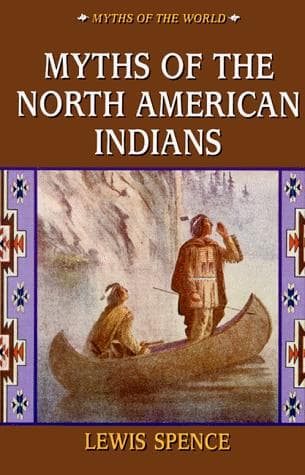
The Myths of the North American IndiansSpence, Lewis
History
The Myths of the North American Indians
Spence, Lewis
Indian mythology -- North America; Indians of North America -- Folklore
The people met them with delighted acclamations, and the famine was at
an end. Yet there were still some difficulties in the way, for when
they tried to get the herd into the enclosure a large grey bird so
frightened the animals with its dismal note that they refused to enter.
This occurred so often that Nápi suspected that the grey bird was no
other than Buffalo-stealer. Changing himself into an otter, he lay by
the side of a river and pretended to be dead. The greedy bird saw what
he thought to be a dead otter, and pounced upon it, whereupon Nápi
seized him by the leg and bore him off to the camp. By way of
punishment he was tied over the smoke-hole of the wigwam, where his
grey feathers soon became black and his life a burden to him.
"Spare me!" he cried. "Let me return to my wife and child. They will
surely starve."
{212}
His piteous appeals moved the heart of Nápi, and he let him go, but not
without an admonition.
"Go," said he, "and hunt for food, that you may support your wife and
child. But do not take more than you need, or you shall die."
The bird did as he was bidden. But to this day the feathers of the
raven are black, and not grey.
The Story of Kutoyis
There once lived on the banks of the Missouri an old couple who had one
daughter, their only child. When she grew to be a woman she had a
suitor who was cruel and overbearing, but as she loved him her parents
offered no opposition to their marriage. Indeed, they gave the bride
the best part of their possessions for a dowry, so that she and her
husband were rich, while her father and mother lived in a poor lodge
and had very little to eat. The wicked son-in-law took advantage of
their kindness in every way. He forced the old man to accompany him on
his hunting expeditions, and then refused to share the game with him.
Sometimes one would kill a buffalo and sometimes the other, but always
it was the younger man who got the best of the meat and who made
himself robes and moccasins from the hide.
Thus the aged couple were nearly perishing from cold and hunger. Only
when her husband was out hunting would the daughter venture to carry a
morsel of meat to her parents.
On one occasion the younger man called in his overbearing way to his
father-in-law, bidding him help in a buffalo-hunt. The old man,
reduced by want almost to a skeleton, was too much afraid of the tyrant
to venture to disobey him, so he accompanied him in the chase. Ere
long they encountered a fine buffalo, {213} whereupon both drew their
bows and fired. But it was the arrow of the elder man which pierced
the animal and brought it to the ground. The old man set himself to
skin the buffalo, for his son-in-law never shared in these tasks, but
left them to his companion. While he was thus engaged the latter
observed a drop of blood on one of his arrows which had fallen to the
ground.
Public-domain text, read in full here on John Shaqi.
Reviews
Reviews
No reviews yet
Be the first to share your thoughts on this work.
Elsewhere in the archive
Join the Discussion
Join the discussion
Sign in to leave a comment or review.
Sign InorCreate an account