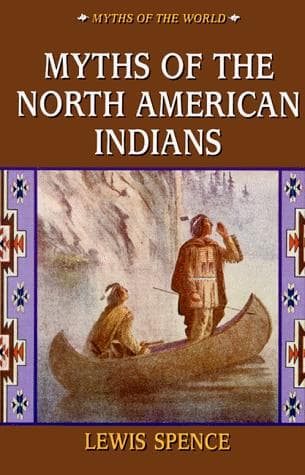
The Myths of the North American IndiansSpence, Lewis
History
The Myths of the North American Indians
Spence, Lewis
Indian mythology -- North America; Indians of North America -- Folklore
The youth stood alone for a little while till he heard
the sound of a fierce tempest. Out of the hurricane
Great Head called to the brothers to arise. In a
moment they were all on their feet, receiving the
congratulations of their younger brother and each
other, and filled with joy at their reunion.
{236}
The Seneca's Revenge
A striking story is told of a Seneca youth who for
many years and through a wearisome captivity nourished
the hope of vengeance so dear to the Indian soul. A
certain tribe of the Senecas had settled on the shores
of Lake Erie, when they were surprised by their ancient
enemies the Illinois, and in spite of a stout resistance
many of them were slain, and a woman and a boy
taken prisoner. When the victors halted for the night
they built a great fire, and proceeded to celebrate their
success by singing triumphant songs, in which they
commanded the boy to join them. The lad pretended
that he did not know their language, but said that he
would sing their song in his own tongue, to which
they assented; but instead of a pæan in their praise
he sang a song of vengeance, in which he vowed that
if he were spared all of them would lose their scalps.
A few days afterward the woman became so exhausted
that she could walk no farther, so the Illinois slew her.
But before she died she extracted a promise from the
boy that he would avenge her, and would never cease
to be a Seneca.
In a few days they arrived at the Illinois camp,
where a council was held to consider the fate of the
captive lad. Some were for instantly putting him to
death, but their chief ruled that should he be able to
live through their tortures he would be worthy of
becoming an Illinois. They seized the wretched lad
and held his bare feet to the glowing council-fire, then
after piercing them they told him to run a race. He
bounded forward, and ran so swiftly that he soon
gained the Great House of the tribe, where he seated
himself upon a wild-cat skin.
Another council was held, and the Illinois braves
{237}
agreed that the lad possessed high courage and would
make a great warrior; but others argued that he knew
their war-path and might betray them, and it was finally
decided that he should be burnt at the stake. As he
was about to perish in this manner an aged warrior
suggested that if he were able to withstand their last
torture he should be permitted to live. Accordingly
he held the unfortunate lad under water in a pool until
only a spark of life remained in him, but he survived,
and became an Illinois warrior.
Public-domain text, read in full here on John Shaqi.
Reviews
Reviews
No reviews yet
Be the first to share your thoughts on this work.
Elsewhere in the archive
Join the Discussion
Join the discussion
Sign in to leave a comment or review.
Sign InorCreate an account