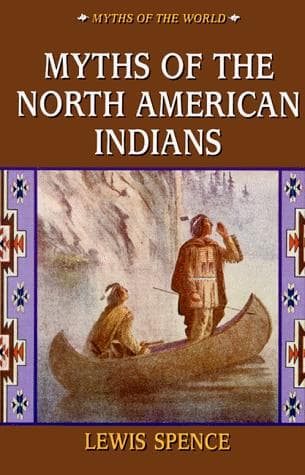
The Myths of the North American IndiansSpence, Lewis
History
The Myths of the North American Indians
Spence, Lewis
Indian mythology -- North America; Indians of North America -- Folklore
He married the chief's daughter, and was made head chieftain by his
father-in-law. The people built a lodge for him in the centre of the
encampment, and brought him many valuable presents of clothing and
horses. On his marriage-day the criers were sent out to tell the
people that on the following day no one must leave the village or do
any work.
On the morrow all the men of the tribe went out to hunt buffaloes, and
the young chieftain accompanied {296} them. By means of his magic
piece of iron he charmed many buffaloes, and slew more than did the
others.
Now it so happened that the chief's remaining son was very jealous of
his brother-in-law. He thought his father should have given him the
chieftainship, and the honours accorded by the people to his young
relative were exceedingly galling to him. So he made up his mind to
kill the youth and destroy his beautiful white horse. But the
sagacious beast told its master that some one was plotting against his
life, and, duly warned, he watched in the stable every night.
On the occasion of a second great buffalo hunt the wicked schemer found
his opportunity. By waving his robe he scared the buffaloes and caused
them to close in on the youth and trample him to death. But when the
herd had scattered and moved away there was no trace of the young brave
or of his milk-white steed. They had returned to the Underworld.
White Feather the Giant-Killer
There once dwelt in the heart of a great forest an old man and his
grandchild. So far as he could remember, the boy had never seen any
human being but his grandfather, and though he frequently questioned
the latter on the subject of his relatives he could elicit no
information from him. The truth was that they had perished at the
hands of six great giants. The nation to which the boy belonged had
wagered their children against those of the giants that they would beat
the latter in a race. Unfortunately the giants won, the children of
the rash Indians were forfeited, and all were slain with the exception
of little Chácopee, whose grandfather had taken charge of him. The
child learned to hunt and fish, and seemed quite contented and happy.
{297}
Public-domain text, read in full here on John Shaqi.
Reviews
Reviews
No reviews yet
Be the first to share your thoughts on this work.
Elsewhere in the archive
Join the Discussion
Join the discussion
Sign in to leave a comment or review.
Sign InorCreate an account