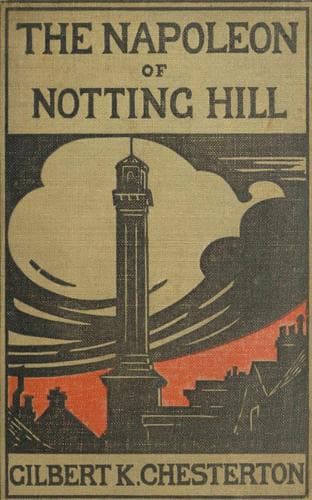
The Napoleon of Notting HillChesterton, G. K. (Gilbert Keith)
Science
The Napoleon of Notting Hill
Chesterton, G. K. (Gilbert Keith)
Fantasy fiction; Notting Hill (London, England) -- Fiction; Political fiction
He passed through the Ossington Gate, surmounted by a great lion,
wrought in red copper on yellow brass, with the motto, "Nothing Ill."
The guard in red and gold saluted him with his halberd.
It was about sunset, and the lamps were being lit. Auberon paused to
look at them, for they were Chiffy's finest work, and his artistic eye
never failed to feast on them. In memory of the Great Battle of the
Lamps, each great iron lamp was surmounted by a veiled figure, sword
in hand, holding over the flame an iron hood or extinguisher, as if
ready to let it fall if the armies of the South and West should again
show their flags in the city. Thus no child in Notting Hill could play
about the streets without the very lamp-posts reminding him of the
salvation of his country in the dreadful year.
"Old Wayne was right in a way," commented the King. "The sword does
make things beautiful. It has made the whole world romantic by now.
And to think people once thought me a buffoon for suggesting a
romantic Notting Hill. Deary me, deary me! (I think that is the
expression)--it seems like a previous existence."
Turning a corner, he found himself in Pump Street, opposite the four
shops which Adam Wayne had studied twenty years before. He entered
idly the shop of Mr. Mead, the grocer. Mr. Mead was somewhat older,
like the rest of the world, and his red beard, which he now wore with
a moustache, and long and full, was partly blanched and discoloured.
He was dressed in a long and richly embroidered robe of blue, brown,
and crimson, interwoven with an Eastern complexity of pattern, and
covered with obscure symbols and pictures, representing his wares
passing from hand to hand and from nation to nation. Round his neck
was the chain with the Blue Argosy cut in turquoise, which he wore as
Grand Master of the Grocers. The whole shop had the sombre and
sumptuous look of its owner. The wares were displayed as prominently
as in the old days, but they were now blended and arranged with a
sense of tint and grouping, too often neglected by the dim grocers of
those forgotten days. The wares were shown plainly, but shown not so
much as an old grocer would have shown his stock, but rather as an
educated virtuoso would have shown his treasures. The tea was stored
in great blue and green vases, inscribed with the nine indispensable
sayings of the wise men of China. Other vases of a confused orange and
purple, less rigid and dominant, more humble and dreamy, stored
symbolically the tea of India. A row of caskets of a simple silvery
metal contained tinned meats. Each was wrought with some rude but
rhythmic form, as a shell, a horn, a fish, or an apple, to indicate
what material had been canned in it.
"Your Majesty," said Mr. Mead, sweeping an Oriental reverence. "This
is an honour to me, but yet more an honour to the city."
Auberon took off his hat.
"Mr. Mead," he said, "Notting Hill, whether in giving or taking, can
deal in nothing but honour. Do you happen to sell liquorice?"
Public-domain text, read in full here on John Shaqi.
Reviews
Reviews
No reviews yet
Be the first to share your thoughts on this work.
Elsewhere in the archive
Join the Discussion
Join the discussion
Sign in to leave a comment or review.
Sign InorCreate an account