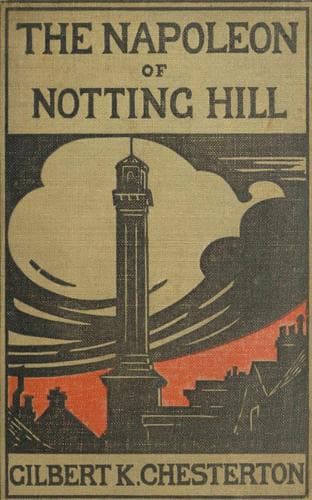
The Napoleon of Notting HillChesterton, G. K. (Gilbert Keith)
Science
The Napoleon of Notting Hill
Chesterton, G. K. (Gilbert Keith)
Fantasy fiction; Notting Hill (London, England) -- Fiction; Political fiction
"What is the object of supper?" cried Buck, furiously. "Isn't it
obvious? This military science is mere common sense. The object of a
street is to lead from one place to another; therefore all streets
join; therefore street fighting is quite a peculiar thing. You
advanced into that hive of streets as if you were advancing into an
open plain where you could see everything. Instead of that, you were
advancing into the bowels of a fortress, with streets pointing at you,
streets turning on you, streets jumping out at you, and all in the
hands of the enemy. Do you know what Portobello Road is? It is the
only point on your journey where two side streets run up opposite each
other. Wayne massed his men on the two sides, and when he had let
enough of your line go past, cut it in two like a worm. Don't you see
what would have saved you?"
Barker shook his head.
"Can't your 'atmosphere' help you?" asked Buck, bitterly. "Must I
attempt explanations in the romantic manner? Suppose that, as you were
fighting blindly with the red Notting Hillers who imprisoned you on
both sides, you had heard a shout from behind them. Suppose, oh,
romantic Barker! that behind the red tunics you had seen the blue and
gold of South Kensington taking them in the rear, surrounding them in
their turn and hurling them on to your halberds."
"If the thing had been possible," began Barker, cursing.
"The thing would have been as possible," said Buck, simply, "as simple
as arithmetic. There are a certain number of street entries that lead
to Pump Street. There are not nine hundred; there are not nine
million. They do not grow in the night. They do not increase like
mushrooms. It must be possible, with such an overwhelming force as we
have, to advance by all of them at once. In every one of the arteries,
or approaches, we can put almost as many men as Wayne can put into the
field altogether. Once do that, and we have him to demonstration. It
is like a proposition of Euclid."
"You think that is certain?" said Barker, anxious, but dominated
delightfully.
"I'll tell you what I think," said Buck, getting up jovially. "I
think Adam Wayne made an uncommonly spirited little fight; and I think
I am confoundedly sorry for him."
"Buck, you are a great man!" cried Barker, rising also. "You've
knocked me sensible again. I am ashamed to say it, but I was getting
romantic. Of course, what you say is adamantine sense. Fighting, being
physical, must be mathematical. We were beaten because we were neither
mathematical nor physical nor anything else--because we deserved to be
beaten. Hold all the approaches, and with our force we must have him.
When shall we open the next campaign?"
"Now," said Buck, and walked out of the bar.
"Now!" cried Barker, following him eagerly. "Do you mean now? It is so
late."
Buck turned on him, stamping.
"Do you think fighting is under the Factory Acts?" he said; and he
called a cab. "Notting Hill Gate Station," he said; and the two drove
off.
Public-domain text, read in full here on John Shaqi.
Reviews
Reviews
No reviews yet
Be the first to share your thoughts on this work.
Elsewhere in the archive
Join the Discussion
Join the discussion
Sign in to leave a comment or review.
Sign InorCreate an account