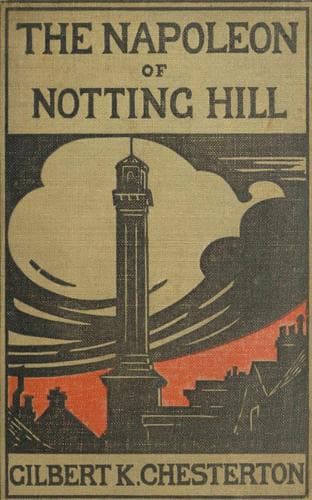
The Napoleon of Notting HillChesterton, G. K. (Gilbert Keith)
Science
The Napoleon of Notting Hill
Chesterton, G. K. (Gilbert Keith)
Fantasy fiction; Notting Hill (London, England) -- Fiction; Political fiction
"Forward, my beauty, my Arab," he said, patting the omnibus
encouragingly, "fleetest of all thy bounding tribe. Are thy relations
with thy driver, I wonder, those of the Bedouin and his steed? Does he
sleep side by side with thee--"
His meditations were broken by a sudden and jarring stoppage. Looking
over the edge, he saw that the heads of the horses were being held
by men in the uniform of Wayne's army, and heard the voice of an
officer calling out orders.
[Illustration: KING AUBERON DESCENDED FROM THE OMNIBUS WITH DIGNITY.]
King Auberon descended from the omnibus with dignity. The guard or
picket of red halberdiers who had stopped the vehicle did not number
more than twenty, and they were under the command of a short, dark,
clever-looking young man, conspicuous among the rest as being clad in
an ordinary frock-coat, but girt round the waist with a red sash and a
long seventeenth-century sword. A shiny silk hat and spectacles
completed the outfit in a pleasing manner.
"To whom have I the honour of speaking?" said the King, endeavouring
to look like Charles I., in spite of personal difficulties.
The dark man in spectacles lifted his hat with equal gravity.
"My name is Bowles," he said. "I am a chemist. I am also a captain of
O company of the army of Notting Hill. I am distressed at having to
incommode you by stopping the omnibus, but this area is covered by our
proclamation, and we intercept all traffic. May I ask to whom I have
the honour--Why, good gracious, I beg your Majesty's pardon. I am
quite overwhelmed at finding myself concerned with the King."
Auberon put up his hand with indescribable grandeur.
"Not with the King," he said; "with the special war correspondent of
the _Court Journal_."
"I beg your Majesty's pardon," began Mr. Bowles, doubtfully.
"Do you call me Majesty? I repeat," said Auberon, firmly, "I am a
representative of the press. I have chosen, with a deep sense of
responsibility, the name of Pinker. I should desire a veil to be drawn
over the past."
"Very well, sir," said Mr. Bowles, with an air of submission, "in our
eyes the sanctity of the press is at least as great as that of the
throne. We desire nothing better than that our wrongs and our glories
should be widely known. May I ask, Mr. Pinker, if you have any
objection to being presented to the Provost and to General Turnbull?"
"The Provost I have had the honour of meeting," said Auberon, easily.
"We old journalists, you know, meet everybody. I should be most
delighted to have the same honour again. General Turnbull, also, it
would be a gratification to know. The younger men are so interesting.
We of the old Fleet Street gang lose touch with them."
"Will you be so good as to step this way?" said the leader of O
company.
"I am always good," said Mr. Pinker. "Lead on."
CHAPTER III--_The Great Army of South Kensington_
Public-domain text, read in full here on John Shaqi.
Reviews
Reviews
No reviews yet
Be the first to share your thoughts on this work.
Elsewhere in the archive
Join the Discussion
Join the discussion
Sign in to leave a comment or review.
Sign InorCreate an account