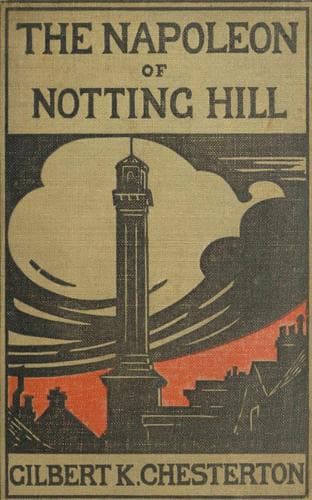
The Napoleon of Notting HillChesterton, G. K. (Gilbert Keith)
Science
The Napoleon of Notting Hill
Chesterton, G. K. (Gilbert Keith)
Fantasy fiction; Notting Hill (London, England) -- Fiction; Political fiction
"Will you pardon a little egotism? Every one likes a little egotism,
when it takes the form, as mine does in this case, of a disgraceful
confession. The thing is really a little interesting, because it shows
how the merely artistic habit has bitten into men like me. It was the
most intensely exciting occurrence that had ever come to me in my
life; and I was really intensely excited about it. And yet, as we
turned that corner, the first impression I had was of something that
had nothing to do with the fight at all. I was stricken from the sky
as by a thunderbolt, by the height of the Waterworks Tower on Campden
Hill. I don't know whether Londoners generally realise how high it
looks when one comes out, in this way, almost immediately under it.
For the second it seemed to me that at the foot of it even human war
was a triviality. For the second I felt as if I had been drunk with
some trivial orgie, and that I had been sobered by the shock of that
shadow. A moment afterwards, I realised that under it was going on
something more enduring than stone, and something wilder than the
dizziest height--the agony of man. And I knew that, compared to that,
this overwhelming tower was itself a triviality; it was a mere stalk
of stone which humanity could snap like a stick.
"I don't know why I have talked so much about this silly old
Waterworks Tower, which at the very best was only a tremendous
background. It was that, certainly, a sombre and awful landscape,
against which our figures were relieved. But I think the real reason
was, that there was in my own mind so sharp a transition from the
tower of stone to the man of flesh. For what I saw first when I had
shaken off, as it were, the shadow of the tower, was a man, and a man
I knew.
"Lambert stood at the further corner of the street that curved round
the tower, his figure outlined in some degree by the beginning of
moonrise. He looked magnificent, a hero; but he looked something much
more interesting than that. He was, as it happened, in almost
precisely the same swaggering attitude in which he had stood nearly
fifteen years ago, when he swung his walking-stick and struck it into
the ground, and told me that all my subtlety was drivel. And, upon my
soul, I think he required more courage to say that than to fight as he
does now. For then he was fighting against something that was in the
ascendant, fashionable, and victorious. And now he is fighting (at the
risk of his life, no doubt) merely against something which is already
dead, which is impossible, futile; of which nothing has been more
impossible and futile than this very sortie which has brought him into
contact with it. People nowadays allow infinitely too little for the
psychological sense of victory as a factor in affairs. Then he was
attacking the degraded but undoubtedly victorious Quin; now he is
attacking the interesting but totally extinguished Wayne.
Public-domain text, read in full here on John Shaqi.
Reviews
Reviews
No reviews yet
Be the first to share your thoughts on this work.
Elsewhere in the archive
Join the Discussion
Join the discussion
Sign in to leave a comment or review.
Sign InorCreate an account