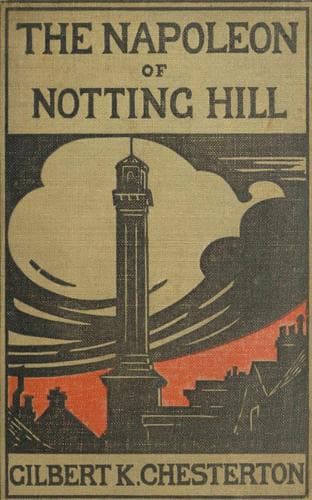
The Napoleon of Notting HillChesterton, G. K. (Gilbert Keith)
Science
The Napoleon of Notting Hill
Chesterton, G. K. (Gilbert Keith)
Fantasy fiction; Notting Hill (London, England) -- Fiction; Political fiction
"I cannot endure to remain here. Everything makes it worse than it
need be. The dawn, for instance, has broken round Campden Hill;
splendid spaces of silver, edged with gold, are torn out of the sky.
Worse still, Wayne and his men feel the dawn; their faces, though
bloody and pale, are strangely hopeful ... insupportably pathetic.
Worst of all, for the moment they are winning. If it were not for Buck
and the new army they might just, and only just, win.
"I repeat, I cannot stand it. It is like watching that wonderful play
of old Maeterlinck's (you know my partiality for the healthy, jolly
old authors of the nineteenth century), in which one has to watch the
quiet conduct of people inside a parlour, while knowing that the very
men are outside the door whose word can blast it all with tragedy. And
this is worse, for the men are not talking, but writhing and bleeding
and dropping dead for a thing that is already settled--and settled
against them. The great grey masses of men still toil and tug and
sway hither and thither around the great grey tower; and the tower is
still motionless, as it will always be motionless. These men will be
crushed before the sun is set; and new men will arise and be crushed,
and new wrongs done, and tyranny will always rise again like the sun,
and injustice will always be as fresh as the flowers of spring. And
the stone tower will always look down on it. Matter, in its brutal
beauty, will always look down on those who are mad enough to consent
to die, and yet more mad, since they consent to live."
* * * * *
Thus ended abruptly the first and last contribution of the Special
Correspondent of the _Court Journal_ to that valued periodical.
The Correspondent himself, as has been said, was simply sick and
gloomy at the last news of the triumph of Buck. He slouched sadly down
the steep Aubrey Road, up which he had the night before run in so
unusual an excitement, and strolled out into the empty dawn-lit main
road, looking vaguely for a cab. He saw nothing in the vacant space
except a blue-and-gold glittering thing, running very fast, which
looked at first like a very tall beetle, but turned out, to his great
astonishment, to be Barker.
"Have you heard the good news?" asked that gentleman.
"Yes," said Quin, with a measured voice. "I have heard the glad
tidings of great joy. Shall we take a hansom down to Kensington? I see
one over there."
They took the cab, and were, in four minutes, fronting the ranks of
the multitudinous and invincible army. Quin had not spoken a word all
the way, and something about him had prevented the essentially
impressionable Barker from speaking either.
Public-domain text, read in full here on John Shaqi.
Reviews
Reviews
No reviews yet
Be the first to share your thoughts on this work.
Elsewhere in the archive
Join the Discussion
Join the discussion
Sign in to leave a comment or review.
Sign InorCreate an account