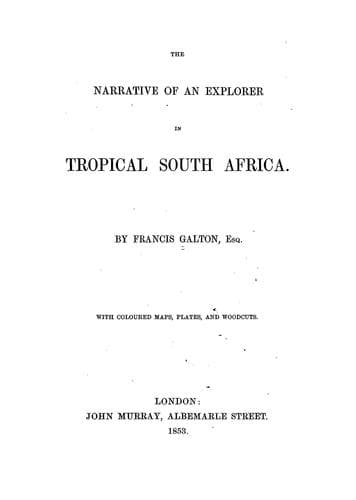
The narrative of an explorer in tropical South AfricaGalton, Francis
History
The narrative of an explorer in tropical South Africa
Galton, Francis
South Africa -- Description and travel
Chapupa passed most of the time with us; he had been much indebted to
Nangoro for assistance in some Damara squabbles and fightings, and was
tolerably intelligent and friendly. It seemed that the Ovampo carry on
a cattle trade with the Damaras at this point. Two Ovampo caravans,
each consisting of from twenty to thirty men on foot, come here with
beads, shells, assegais, wood-choppers, and such-like things, which they
exchange for cattle. They obtain the beads and some of the assegais from
the half-caste Portuguese traders who frequent their northern frontier.
Some years back the then principal Damara chief received the Ovampo with
great civility, and allowed them, as usual, to travel about and barter as
they liked; but when they had sold everything and brought a fine drove
of cattle together, the chief attacked and robbed them. Chapupa was at
that time a second-rate captain, and having been himself robbed he sent
to Nangoro for help, which was given; their men joined together, killed
the obnoxious chief, and then divided his cattle between them; and
Chapupa now lives in great plenty, and shows the greatest respect towards
all the Ovampo. He evidently did not wish to take the responsibility of
himself sending me on to Nangoro, as he feared that I might be a spy, and
that Nangoro would find fault with him for allowing me an opportunity of
learning the road; but he begged that I would wait till the next Ovampo
caravan came, when I should have an excellent opportunity of returning
with it.
However, on the 25th of April, a man offered himself as guide; I asked
him how soon he would be ready: he replied, as was very true, that he
had nothing to pack up, only his assegai to take with him, and would
start directly. These savages look with great contempt at our wants, and
indeed no European could be a match for them in fatigue-work for two or
three days; yet, on the other hand, in a long steady journey the savages
very quickly knock up, unless they adopt some of our usages. They cannot
endure the cold for many nights without a rug to cover them. The midday
sun gives them a headache, and they require a cap. Their sandals do not
keep out the thorns, and they have to make shoes, and they cannot do more
than a week’s work on pig-nut diet. A savage who makes a dash at work for
three or four days gets through it well enough, and a long rest sets him
to rights again after his forced exertions; but where there is no such
rest, but in its place a steady continuous strain, then he fails unless
to a considerable degree he adopts our dress and habits.
Public-domain text, read in full here on John Shaqi.
Reviews
Reviews
No reviews yet
Be the first to share your thoughts on this work.
Elsewhere in the archive
Join the Discussion
Join the discussion
Sign in to leave a comment or review.
Sign InorCreate an account