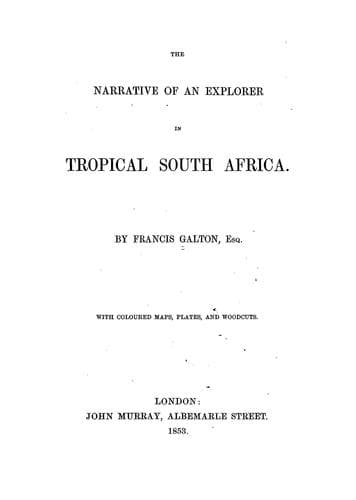
The narrative of an explorer in tropical South AfricaGalton, Francis
History
The narrative of an explorer in tropical South Africa
Galton, Francis
South Africa -- Description and travel
_April 28th._—After some hours’ travel the guide confessed that he had no
idea where we were; so we separated to look for tracks, some climbing one
hill and some another. The day was hazy, but Andersson made out something
like green grass, five or six miles to the north-west, and the guide
found a bushman who directed him in that very course; so we went there,
and found not only dry rushes but also a troop of baboons. This was a
sure sign of there being water somewhere near, and after looking about a
little we came upon wells. We generally found water by observing geese,
ducks, baboons, parrots, doves, and little birds (not linnets) in flocks.
Guinea fowl are seldom more than three hours from water. Plovers I have
seen much further. Fresh converging tracks of men or animals of course
indicate it, but old _paths_ only mislead; these generally are made when
the ground is soft during the rainy season, and lead to some vley which
is dry at all other times. In practice, when looking out for water, the
first sign that gives hope is a flock of Guinea fowls, then following the
lay of the country every distant tree is carefully scanned until a parrot
is seen, which, as the bird is fond of perching on the very topmost
branches, is, even at great distances, a conspicuous object. A parrot is
seldom more than half an hour from water, nor baboons either. Continuing
a sharp look-out, and taking a likely course doves are seen flying about,
and little birds are found in all the bushes, and they are close upon it.
The well and fountain that we were at was called Otchikango; a bold range
of hills bounded it on one side, and along their foot a considerable
sheet of water appeared to have lain in the rainy seasons. The guide
recognised the place as the station he had wanted to take us to, and
promised that there should now be no further mistakes.
_April 29th._—We went on, and after straying for three and a half hours,
came again to a nonplus; we had cleared the mountains, and a thick mass
of shrubs lay before us. The guide had been following an old elephant, or
some other wild beast path, instead of the Ovampo track. I made him climb
a pretty stiff hill with me, the cactus and broken stones of which he
did not at all like,—but it was of no use to us. A wide forest extended
below, without a landmark, so we came down and returned to Otchikango.
Public-domain text, read in full here on John Shaqi.
Reviews
Reviews
No reviews yet
Be the first to share your thoughts on this work.
Elsewhere in the archive
Join the Discussion
Join the discussion
Sign in to leave a comment or review.
Sign InorCreate an account