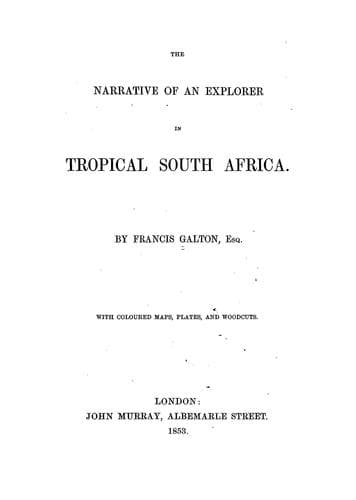
The narrative of an explorer in tropical South AfricaGalton, Francis
History
The narrative of an explorer in tropical South Africa
Galton, Francis
South Africa -- Description and travel
_May 27th._—We travelled through the everlasting thorns and stones for
nine hours, and off-packed at wells—wretched affairs, that we had to sit
up half the night to clean and dig out.
_May 29th._—We came on ox spoors. Old Netjo, who is a family man, was
beside himself with joy, and kept by my side pointing out all the
indications of the neighbouring Ovampo. Passing a reedy, boggy fountain,
we came an hour after to Omutchamatunda, which then was thronged with the
Ovampo and their cattle. We were received very hospitably, and had a tree
assigned us to camp under. The Ovampo gave us butter to grease ourselves
with; but as it was clean, and as they also brought corn, I preferred
eating it. There was a little game about, and we had some shooting, and
also a bathe and a battue of ducks and partridges. No corn was grown
here, neither were there any women; it was simply a cattle-post, and far
from the corn country of the Ovampo.
_May 30th._—We passed the grave of the god, Omakuru; the Damaras all
threw stones on the cairn that covered it, singing out Tati-kuru!
Tati-kuru! (Father Omakuru). Came to Etosha, a great salt-pan. It is
very remarkable in many ways. The borders are defined and wooded; its
surface is flat and effloresced, and the mirage excessive over it; it
was about nine miles in breadth, but the mirage prevented my guessing at
its length; it certainly exceeded fifteen miles. Chik said it was quite
impassable after the rainy season; and it must form a rather pretty lake
at that time. We arrived late in the evening at another werft, on the
south border of the grand flat, Otchihako-wa-Motenya, which appears to
extend as a grassy treeless estuary between wooded banks the whole way
hence to near the sea. The Ovampo here could not believe that I was able
to express sounds by writing on paper, so I jotted down the names of a
number of people, one after the other, and then read them out. I may
as well give a few of them, as a guide to the rhythm of the language:
Kangŭrà, Entongò, Epingà, Angèrò, Andāhè, Akoosà. I planned a shooting
match; there were a great many naturalised Bushmen on the spot, and
as all the Ovampo carry bows, I had a large archery meeting. I put up
a sheep-skin (which gives a target of about three feet by two), and
placed the men eighty paces from it. The prize was tobacco; there were
twenty competitors, and each shot six arrows, so that 120 shots were
made; but out of these 120 only _one_ hit the target fairly, and another
brushed it. At very near distances, as from five to ten yards, the men
shot perfectly. I have frequently given prizes to Damaras, Bushmen, and
Ovampo, to shoot for, but I have only seen wretched archery practice,
far worse than that of our societies in England. I suppose I have been
unfortunate; but though I have taken some trouble to see good practice,
not only with bows and arrows, but also with rifles, I have never
witnessed performances that approached to the accuracy which shooters
Public-domain text, read in full here on John Shaqi.
Reviews
Reviews
No reviews yet
Be the first to share your thoughts on this work.
Elsewhere in the archive
Join the Discussion
Join the discussion
Sign in to leave a comment or review.
Sign InorCreate an account