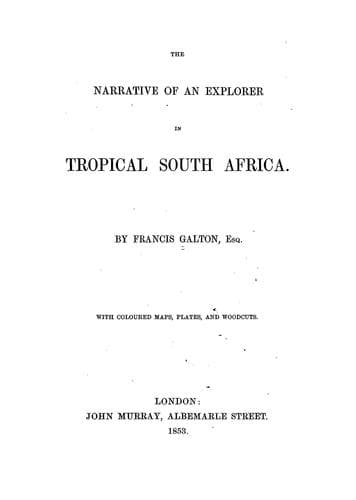
The narrative of an explorer in tropical South AfricaGalton, Francis
History
The narrative of an explorer in tropical South Africa
Galton, Francis
South Africa -- Description and travel
The harvest was now over; but the high stubble was still standing, and
in it the oxen were allowed to feed. There was at this time hardly any
other pasturage for them. The Ovampo have two kinds of corn; one is the
Egyptian doura (or exactly like it), a sort of hominy; and the other
is a corn that was new to me, but kindred, as I am told, to the Indian
“badjera:” its head is cylindrical, and full of small gray seeds, which,
though not larger than those of millet, are so numerous that each head
contains a vast deal of nutriment. Both kinds of corn grow to much the
same height, about eight feet; and in harvesting the reapers bend down
the stalks and only cut off the heads. As we journeyed on the next day
our surprise at the agricultural opulence of the country was in no way
decreased. Chik told us a great deal about the tenure of the farms, and
the way they dig them. Each farmer has to pay a certain proportion of
the tobacco that he grows to Nangoro (tobacco is the chief circulating
medium in Ovampo-land); but the corn can be planted without any drawback
upon it. The fields are hoed over before each sowing season, and the corn
planted. The manure from the cattle kraal is spread over the ground.
They plant beans and peas, but adopt no systematic rotation of crops.
The palms that grew here were of the same sort as those that I saw near
Omanbondè; but the fruit of these was excellent, exactly like those of
the Egyptian doum, while that of the others was bitter. The other trees
that I observed were fruit trees: they were sparingly scattered over the
country; but nearly all that I saw were of magnificent size, as large
as those in any English park; their foliage was so dense and green that
a real shade from the sun could be obtained, which never is the case in
Damara-land, as the straggling stunted thorn, with its few shrivelled
leaves, offers little more of a screen to its rays than an English tree
in winter time. The fruits are of two kinds, one, which I never saw
myself as it was not the season for it, was a kind of cherry, according
to Timboo’s authority, who recognised at once all the produce of his own
country (Masapa, by Moviza) here in Ovampo-land. The other is a very acid
fruit, not unlike an apple in shape, colour, smell, and size, but with a
stone in it. No other tree stands in the corn country of the Ovampo, or
at least gives any feature to the landscape.
Public-domain text, read in full here on John Shaqi.
Reviews
Reviews
No reviews yet
Be the first to share your thoughts on this work.
Elsewhere in the archive
Join the Discussion
Join the discussion
Sign in to leave a comment or review.
Sign InorCreate an account