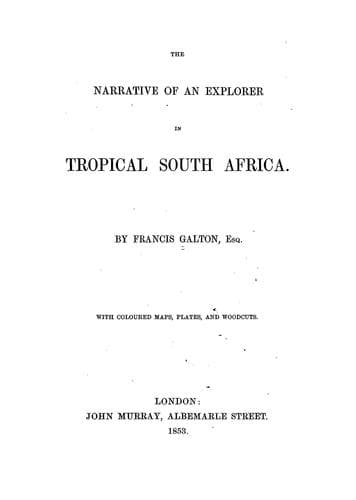
The narrative of an explorer in tropical South AfricaGalton, Francis
History
The narrative of an explorer in tropical South Africa
Galton, Francis
South Africa -- Description and travel
Now came the question what was to be done. The river was four long
days ahead. It was a goal to reach, and in itself probably well worth
visiting. Its commercial importance might be great, as it appears to
offer a high road into the very centre of Africa, through countries
which, if as healthy as Ovampo or Damara-land, leave nothing to be
desired on that score. It was precisely the most interesting point of my
whole journey. Ought then a visit to it to be abandoned because Nangoro
would not let us go? Or ought we to push on for it at all hazards? On
the other hand, the river was well known to, and frequented by traders
from Benguela; there would therefore be no difficulty in fully exploring
it from that side; and probably infinitely more could be learnt by
inquiries properly made at Mossamedes than anything that I could report
from having seen it with my own eyes during so cursory a visit as I
proposed. Now, as to the risk I should run by temporising with Nangoro
until I had obtained permission to go there. My oxen would entirely knock
up, and probably die; and then what could I do? Even if I walked back to
the waggons, leaving things of the greatest value to me in Ovampo-land,
the want of ride-oxen would be felt most seriously throughout the return
journey. They were everything to me. It was on them that I explored the
roads, followed tracks, and made the most successful expeditions. If
Omagundè, through whose pasture grounds I must return, was to attack us,
as I thought he most probably would, it must be by the ride-oxen alone
that we should have a chance of escaping. I could not spare them nor risk
losing them. It would be impossible to replace them before many months,
as it is not one ox out of forty that will make a ride-ox, for only those
are fit to break in that show far less gregariousness of disposition than
oxen ordinarily do. The beasts that walk first, and lead the herd, are
the only oxen that can be ridden with any comfort or success; the others
jib and crowd together, and fight with their horns, when you try to urge
them on, and the whole caravan comes to a stand-still. It takes half a
year to break in an ox to anything like travelling purposes; he has not
only to learn to be quiet, but also to bear a weight on his shoulders.
Now, with great trouble I had collected together fifteen efficient ride
and pack-oxen: they were the stay of my party in cases of difficulty or
danger, and I would not for any but the weightiest considerations run
the risk of losing them. With no better supply of water and pasturage
than they were now allowed, I felt sure that though they might reach
the river, and even return to Nangoro’s, yet that they would never see
Damara-land again. I also feared that the Portuguese traders might play
me some tricks, as these half-castes are by no means scrupulous, even
less so than traders are elsewhere; and I could not help thinking of
the way in which our own countrymen had behaved to the late Mr. Ruxton,
Public-domain text, read in full here on John Shaqi.
Reviews
Reviews
No reviews yet
Be the first to share your thoughts on this work.
Elsewhere in the archive
Join the Discussion
Join the discussion
Sign in to leave a comment or review.
Sign InorCreate an account