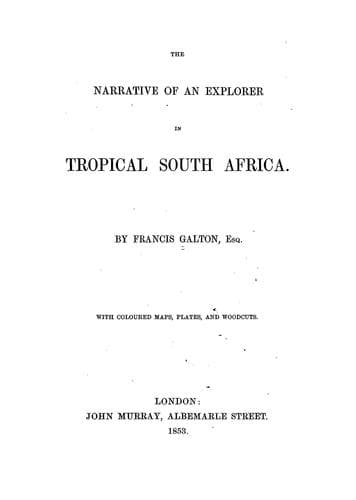
The narrative of an explorer in tropical South AfricaGalton, Francis
History
The narrative of an explorer in tropical South Africa
Galton, Francis
South Africa -- Description and travel
We now trekked steadily up the Omoramba, and one day’s work was like
another’s. There were wells every two, three, or four hours, but deep
ones, and choked with sand, which we had on every occasion to clear out,
working for hours, and often half through the night. The river-bed is
sometimes a broad reach of sand with high banks, sometimes imperceptible,
except to a very practised eye. Thorns of course hem it in.
The few incidents that occurred on our return journey were these. One
night we slept close to water-holes: our encampment was anything but a
quiet one; and the dogs barked all night, as they almost invariably did.
We had watered the oxen out of a heavy wooden trough that Damaras had
made and left at the wells, and this trough blocked up the pathway down
to the largest well. In the morning, to our surprise, we found elephant
spoors all about us: three large ones and two calves. They had pushed the
trough to one side, and walked down to the well till their trunks could
reach the water, and had stamped the sand in, and made a great mess of
our handiwork. Then they had walked close round us till their minds were
satisfied, and finally moved off straight away across country.
A very large springbok was shot, which we weighed against a large and fat
sheep that we killed. The first was 120 pounds; the second, 112 pounds.
Damara sheep stand much higher than our English sheep, and have no wool;
the hair of their hides is like that of a calf. Hans sold two of his curs
to some of the Damaras for two oxen each. I cannot conceive what could
have induced them to make such a bargain. They were keen upon dogs, for
they offered four oxen for another one, “Watch;” but he was too useful to
me in worrying night marauders to be spared.
We had a fine night for chevying hyenas. After one was killed, and
everything was silent, I sent a Damara out among the bushes to imitate
their howl, that we might hear the others answer, and know where they
were. He did it so successfully, that all the dogs were at him in an
instant, and he was bitten.
_July 17th._—Our old friend the hill Omuvereoom came into sight. The air
was very thick and cold at nights. The sky had quite an English November
appearance. We found ice about us nearly every morning since leaving
Ondonga. For the last three weeks I have observed that there is a vast
deal of electricity in the air, every woollen thing crackles when rubbed
with the hand. My large black dog “Wolf” is quite a powerful electrical
machine when his back is stroked down.
_July 25th._—We arrived at Ontikeremba, where there are a great many deep
wells, about four feet in diameter, and thirty feet deep. A row of four
men contrived to hand up the water out of them; but it was as much as
they could do. I can hear nothing of the proceedings of the Hottentots,
during my absence, but learnt the full particulars of Kahikenè’s death.
The bed of the Omoramba is now that of a small sandy streamlet; yet
wells are found in numbers along it.
Public-domain text, read in full here on John Shaqi.
Reviews
Reviews
No reviews yet
Be the first to share your thoughts on this work.
Elsewhere in the archive
Join the Discussion
Join the discussion
Sign in to leave a comment or review.
Sign InorCreate an account