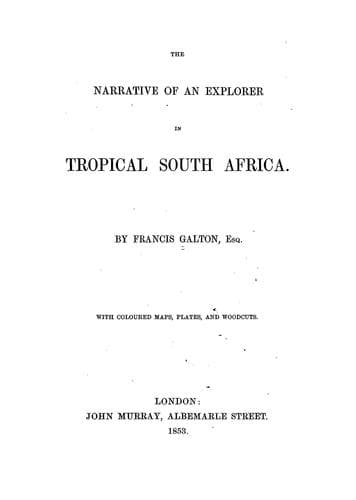
The narrative of an explorer in tropical South AfricaGalton, Francis
History
The narrative of an explorer in tropical South Africa
Galton, Francis
South Africa -- Description and travel
As a way of ridding myself of the waggons and all my remaining
properties, I should arrange with Hans to act as agent for me to convert
them into oxen, and drive them for sale down to the colony, by which
means I should recover some part of their value.
Then in order to occupy the fifteen weeks that I had to spare, I intended
to make a quick journey to the eastward, both for the purpose of seeing
something of the Hottentots, and also to find out whether, as I had at
first been assured was the case, the Karrikarri Desert was interposed as
an impracticable barrier between the sea-coast countries and Lake ’Ngami.
I divided my party into two: one waggon went down with Hans to the bay,
to bring back all the articles of exchange that I had left there; and the
other waggon, together with all my ride-oxen, went with me by Jonker’s
village on my road to the east.
To make matters more secure, I dispatched messengers to the Orange River,
in obtaining whom Swartboy very kindly assisted me; and among my letters,
I wrote one to the agent of the missionaries in Cape Town, offering to
bear a certain part of the expense of the vessel, on condition that it
was dispatched not earlier than the 1st of December, or later than the
last of January. We then busied ourselves for a week in packing, and in
repairs, and in enjoying Mr. Hahn’s kind hospitality.
Mr. Hahn had made an excursion to Omaruru during my absence, in company
with Katjimaha’s sons. It is a spring, situated in the neighbourhood of
extensive pasturage, a very important place to the Damaras, and about
four and a half days’ travel from Barmen, being a little way beyond
Erongo,—the Ghou Damup mountain that I have already mentioned. Omaruru
is a rendezvous for the caravans that travel between the Damaras and the
sea-side Ovampo; and immediately north of it begins a broad barren tract
called the Kaoko, which those caravans have to cross, and which, though
now very thinly inhabited, appears to have been the original home of the
Damara nation.
I heard of the safety of three of my mules who had travelled down to
Scheppmansdorf and taken up their quarters there; they grazed, strayed,
and slept just where they pleased, for the Hottentots could not manage
them. They were five in number when they ran away from me at Schmelen’s
Hope, but two of them must have been killed on the road by lions; they
certainly did not die of starvation, for the other three arrived at
Scheppmansdorf very plump and in good condition.
I ought to mention that the horse distemper does not appear to exist at
Scheppmansdorf: five or six horses have at different times been kept
there, but none have suffered from the disease.
Public-domain text, read in full here on John Shaqi.
Reviews
Reviews
No reviews yet
Be the first to share your thoughts on this work.
Elsewhere in the archive
Join the Discussion
Join the discussion
Sign in to leave a comment or review.
Sign InorCreate an account