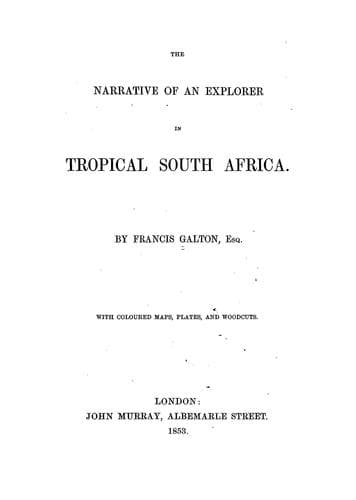
The narrative of an explorer in tropical South AfricaGalton, Francis
History
The narrative of an explorer in tropical South Africa
Galton, Francis
South Africa -- Description and travel
It will be tedious to describe my journey now as minutely as I did that
in Damara-land, for it was much the same thing over again—uncertainty
of the way and want of water; but we had become far quicker and more
self-confident in emergencies, and were altogether a very active and
efficient body of men. Among my Damaras I had two of the smartest men and
best runners that could be found in the country; all of them, indeed,
were picked men, and they had become much attached to us, and worked very
well, and willingly.
In a few hours from Eikhams we had emerged from the valley of the Swakop
on to the high plateau. Thence we followed the Quieep River easterly:
this we left for the Noosop, crossing a broad plain, and having some
shooting; we then followed the Noosop, and game began to appear in
abundance. We passed one great herd of springboks that were migrating;
they eat up the grass almost as locusts would on their way. It was by no
means so numerous a herd as is often seen in Bechuana country; but the
tufts of white hair on the backs of the males were as thickly scattered
over the country as daisies on a lawn. We never had to kill oxen,—only
sheep now and then, for the sake of the fat; for all the game was very
dry; and where you have no vegetables, fat becomes an essential element
of food.
It was a great drawback to us that elands were hardly ever seen in this
country: they are the staple food of sportsmen in Bechuana-land, and are
very fat.
We discovered how to shoot giraffes on foot from Andersson having gone
successfully after a herd in the dusk of the evening, when we found that
they allowed him to stalk close up to them. They see very indistinctly in
the dark. He shot at two, who did not run far when wounded, but seemed
bewildered. He fired all his bullets away at them, and brought one to
a stand-still, and the other to a slow walk; but they would not fall.
He could only find one pebble in the sandy soil to fire out of the gun,
instead of a bullet, and that seemed to have no effect upon the animal:
he then thought of hamstringing them; but though he nicked the skin of
one deeply, yet as he struck out both with his horns and heels when he
did so, it was too dangerous to continue the attempt. In despair, he
took his rifle-barrel (which was a common thick thing) from the stock,
and kept flinging it at the giraffe’s head like a knob-kerrie, and at
length the beast dropped. In the morning the other one had walked away;
and though he was tracked a couple of miles, yet he could not be found.
We jerked the giraffe, that is, cut the flesh that we did not eat into
strips, and dried them in the sun. The skin was of great service to us,
as our shoes were worn out, and wanted new soles. It is strange to see
in how small a compass the meat of the whole animal packs up when it is
dried.
Public-domain text, read in full here on John Shaqi.
Reviews
Reviews
No reviews yet
Be the first to share your thoughts on this work.
Elsewhere in the archive
Join the Discussion
Join the discussion
Sign in to leave a comment or review.
Sign InorCreate an account