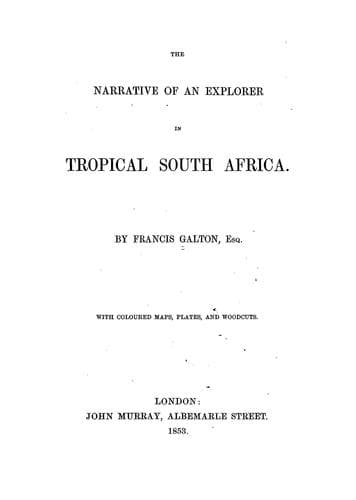
The narrative of an explorer in tropical South AfricaGalton, Francis
History
The narrative of an explorer in tropical South Africa
Galton, Francis
South Africa -- Description and travel
We rode over to ’Twas in eleven hours, following the track of Amiral’s
waggon, and there we found a large werft. I engaged a Dutchman, by
name Saul, whom I found there. He was to take two or three pack-oxen,
and to pack them himself, and to help my party in everything. He was a
well-known shot, spoke Hottentot perfectly, and was just the man I wanted.
It seemed to me that, small as Amiral’s tribe was, it was infinitely the
most civilised of all I had seen, and seemed possessed of more resources
by far than either Swartboy’s or Cornelius’. I mean that, with the usual
articles of exchange, whatever was wanted, might be found and bought
there with far more facility than elsewhere. The others keep no “stock in
hand” of anything, but scramble on from hand to mouth. If you want a pair
of leather trousers made, the goat must be killed and the skin dressed,
for nobody cares to keep a spare piece of leather. In the same way with
carosses, each man has his own sleeping things, but no overplus by him to
sell. Every Hottentot has his ride-ox, which he will not dream of parting
with until he has broken in another one to take its place, and there
is a want of _capital_ everywhere, so that although a traveller may be
abundantly supplied with articles of exchange, and the natives around him
by no means badly off, yet it does not at all follow that he will find
anybody to barter with him as he journeys through their country.
_September 24th._—We left ’Twas on our shooting excursion. I took no
dogs: mine were useless curs for anything else but night-watching; and
under the guidance of Saul we travelled five hours and a half, passing
a succession of little springs on our way. Early the next morning we
went three hours to the place of rendezvous, and Amiral came shortly
afterwards: numbers of other Hottentots soon dropped in, and we had
a very merry evening, telling tales, and talking about the habits of
animals. Of course we had lion and elephant stories in abundance. I was
curious to know what animals here were the most fatal to man, and we
counted over all the deaths that we could think of. Buffaloes (though
not common here) killed the most, then rhinoceroses, and lastly, lions.
Areep, the predecessor of Cornelius, as chief of his tribe, was killed by
a black rhinoceros. It is curious how many people are wounded by lions,
though not killed. A very active Damara, who was some time with me in
Damara-land, but who stayed behind as I journeyed up the country, was
in a dreadfully mangled state when I returned. He had found a lion in
the act of striking down his ox, and rushed at him with his assegai: he
gave him a wound that must have proved mortal, for the assegai went far
into his side; but the lion turned upon him, and seizing him, bit one
elbow-joint quite through, and continued worrying him until some other
Damaras ran up and killed the animal. My servant, Hans, had a very narrow
escape some time since. He was riding old Frieschland (the most useful ox
Public-domain text, read in full here on John Shaqi.
Reviews
Reviews
No reviews yet
Be the first to share your thoughts on this work.
Elsewhere in the archive
Join the Discussion
Join the discussion
Sign in to leave a comment or review.
Sign InorCreate an account