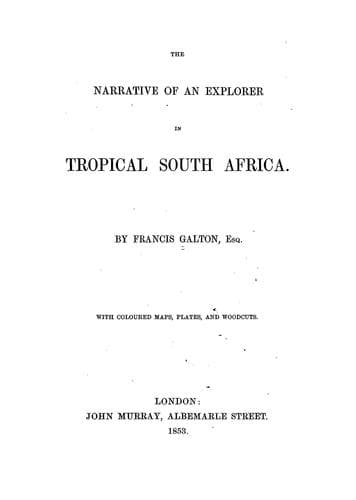
The narrative of an explorer in tropical South AfricaGalton, Francis
History
The narrative of an explorer in tropical South Africa
Galton, Francis
South Africa -- Description and travel
We started for ’Tounobis on the afternoon of Oct. 1st with Amiral and
half of his men; after about three hours we came to a little well that
the Hottentots who were before us had just drank dry, and, going on, to
our delight saw two huge white rhinoceroses, three or four hundred yards
on one side of us. They are indeed immense creatures, so far longer than
the black ones, and their horns so much larger. The rhinoceros now in the
Regent’s Park Gardens is a black rhinoceros; it is much the most vicious
of the two kinds, but nothing like the size of the other. We all tumbled
off our oxen, some twenty of us (the others had returned to Amiral’s
waggons), and ran helter-skelter through the bushes, each his own way,
till we were pretty near them, and then, as one trotted up to see what
was the matter, a volley was blazed into him, that bowled him over like
a hare. The other one took a sweep and escaped unshot. The rapidity
with which the slaughtered one was cut up was perfectly astonishing. I
minuted the whole occurrence; it only took twenty minutes, and we were
in our saddles again thirty-five minutes after we had left them. It
must be recollected that three-penny pocket-knives are not the best of
instruments to make an impression on rhinoceros hide. There is no knife
so good as a common butcher’s knife; as a general rule, soft steel, or
even iron, is far better than hard steel, because you can sharpen the
first on any bit of stone, and the metal does not splinter when it comes
against a bone.
We followed an elephant path, which went as straight as a Roman road. I
took its direction several times with an azimuth compass, and it did not
vary four degrees. We travelled till past nine, having been on the move
for six and a quarter hours.
The next day, starting very early, poor Timmerman and Frieschland both
knocked up; they had never recovered the Ondonga journey: we drove them
as far as we could, but it was no use, and as we of course could not
wait in the middle of the plain without water, we had to leave the poor
creatures to their fate.
Public-domain text, read in full here on John Shaqi.
Reviews
Reviews
No reviews yet
Be the first to share your thoughts on this work.
Elsewhere in the archive
Join the Discussion
Join the discussion
Sign in to leave a comment or review.
Sign InorCreate an account