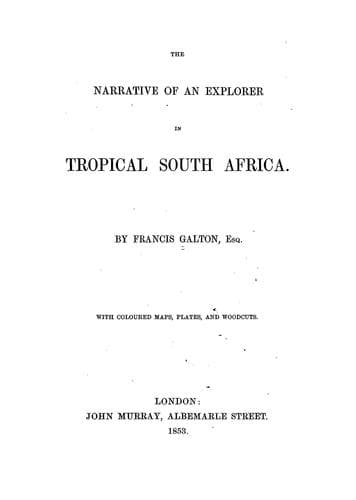
The narrative of an explorer in tropical South AfricaGalton, Francis
History
The narrative of an explorer in tropical South Africa
Galton, Francis
South Africa -- Description and travel
we were tired, a pleasant moonlight evening was spent on much smaller
game—the spring-hare, as the Dutch call it. It is a creature about two
feet long, shaped like a kangaroo in body and tail, but with a different
head; it burrows and lives in holes all day, but at night frisks about
and grazes.
We and the Bushmen arranged ourselves in large circles, enclosing fresh
patches of ground each time, and then beat up towards the centre. We
generally enclosed two or three of these funny creatures, who hopped
about in the oddest way, and we rushed in and assassinated them with
sticks. The sinews of their powerful tails form excellent materials for
sewing carosses.
I worked hard to fix the longitude of ’Tounobis, which I did more
successfully than I could have hoped, as my instrument was a small
and not very legible one, and for want of oil I had to read off the
observations by firelight.
The Bushmen assured me that the character of the country between that
place and the lake was of exactly the same description as that around us,
a sandy soil with not unfrequent dried-up vleys, and covered with trees,
but by no means so thickly as to impede the progress of a waggon.
In fact, if a person wanted to go from Walfisch Bay to the lake, he
would have an excellent waggon-road after he had left Eikhams (Jonker’s
place), one day behind him. He should follow the Quieep River as far as
it goes eastwards, and then make a straight course for Kurrikoop, taking
the chance of vley water by the road; from Kurrikoop, through Elephant’s
Fountain to ’Twas, all is excellent; thence he should follow the foot
of the ridge and not the top of it, as we had done, sending the oxen to
water up the gorges. In the twenty-one hours’ journey to ’Tounobis, three
or four large vleys are passed, in which water would lie for many months.
From there onwards I should have no fear whatever in the rainy season,
even if the Bushmen refused to guide me, because the character of the
country is adapted for holding water; but from Damara-land to the Ovampo
no person could think of travelling without guides, unless there was a
recent track to follow. If he once strayed from the path he would be
hopelessly involved in the thorn thicket.
I fancy that the Bushmen spoke truth about the want of water ahead,
as the droves of animals who had congregated in the neighbourhood of
’Tounobis continued drinking every night, the repeated firing being
insufficient to drive them away; it seemed as though they had no other
neighbouring watering-place to go to.
Public-domain text, read in full here on John Shaqi.
Reviews
Reviews
No reviews yet
Be the first to share your thoughts on this work.
Elsewhere in the archive
Join the Discussion
Join the discussion
Sign in to leave a comment or review.
Sign InorCreate an account