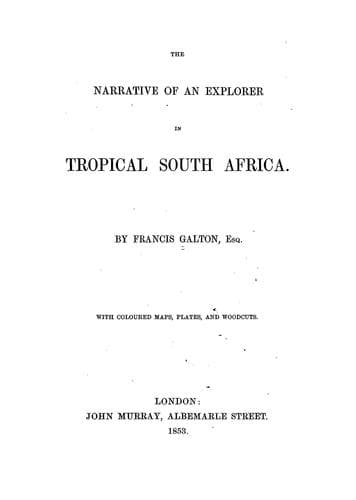
The narrative of an explorer in tropical South AfricaGalton, Francis
History
The narrative of an explorer in tropical South Africa
Galton, Francis
South Africa -- Description and travel
Amiral then told everybody that we were going home as quickly as we
could, for we had no time to spare to make further inquiries about
the lost oxen, and on we went. Our first day was three hours, and we
purposely overshot the gorge which was our mark, that the Damaras who
were on a keen look-out might be convinced that we knew nothing of
Kaipanga’s rascality, and were really going home in good earnest.
Amiral’s men slept a couple of miles away from mine, so as to disarm all
notion of a concerted expedition, but at one o’clock in the morning the
old scamp got up quietly with about half his men and joined me. I left
sufficient people behind to resist any Damaras in case they attacked the
camp during my absence, and we were all off under the escort of Amiral’s
spy at two. It was a very dark night, and we scrambled down the gorge and
through the trees of the plain till about four o’clock, when we stopped,
as there was some doubt as to where we were, and runners were sent ahead
in all directions to explore the country for a mile or two round. Just as
the first streaks of light appeared in the sky the wished-for information
came; there was no time to be lost, and we all ran in a glorious state of
excitement across the country. The light quickly increased, and by the
time that the sky was grey we were all behind a mound, watching keenly
for some indication of the exact position of the werft, which we were
assured was close by us. At length a slender column of smoke was seen,
and instantly the charge was ordered. Amiral, Andersson, and myself,
with four or five others, were to go straight on; ten men were to make
a sweep, and run down upon the werft on the right and ten on the left.
Nobody was to fire unless the natives used their assegais. Off they were;
our party walked slowly to give the others time, but the dogs of the
werft heard us; in an instant the alarm was given, and no time was to
be lost, so we in the centre were obliged to make a rush prematurely;
almost every Damara was off helter-skelter. We caught a few women and
one man; they said that Kaipanga, the chief, whom we were in search of,
was at another werft close by; that he _had_ killed the ox and his men
had eaten it, and that if we would spare them and not kill them they
would show us the way. All this questioning and answering took little
more time to say than it does to read, and we were off again, but the
daylight had become quite strong, and before we were at the next werft
the sun was about to rise. We could not hope to encircle it, so we ran
crouching through the bushes on and into it with much better success
than we could have expected. The Damaras were not half a minute out of
it when we arrived, and were running in all directions. The country was
rather open, and there was a mound close by, to the top of which some
of our men ran directly. This acted like flying a kite over a moor; it
made all the runaway Damaras lie still at once, lest they should be
Public-domain text, read in full here on John Shaqi.
Reviews
Reviews
No reviews yet
Be the first to share your thoughts on this work.
Elsewhere in the archive
Join the Discussion
Join the discussion
Sign in to leave a comment or review.
Sign InorCreate an account