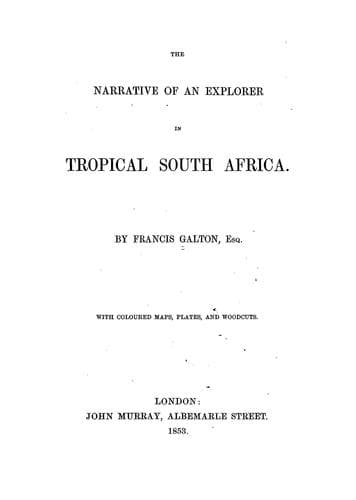
The narrative of an explorer in tropical South AfricaGalton, Francis
History
The narrative of an explorer in tropical South Africa
Galton, Francis
South Africa -- Description and travel
Before starting, having determined in which direction you intend to
proceed, take off the top glass and adjust the head of the fish so that
it shall point in that direction; there is now no chance of error or
confusion; you forget all about the needle and only think of the fish.
When it becomes dark, you have simply to hold up the compass between your
eye and the sky, and the fish can be seen quite plainly; but an ordinary
compass can never be deciphered after dusk. If any doubt remains, the
light of a cigar or a piece of white paper held below the compass will,
when you look down upon it, bring out the fish quite clear and distinct.
It is much better to hang the compass by three threads, like a scale-pan,
than simply to hold it in the hands; the threads take the place of
gimbals, and, besides, being more compact in the pocket, are also less
likely to get out of order. For a pocket-compass, no great accuracy
is required; if the traveller can depend upon it to a point, that is
quite sufficient. Where any bearings for mapping purposes are wanted,
nothing inferior to an azimuth compass should be used, and one of these
I invariably carried in a case sewn on to my shooting-belt, so as to lie
in the small of the back. An almanac should be calculated and written
out for the latitudes and longitudes in which the traveller intends to
go. A simple approximation to accuracy is all one wants, and the same
almanac would do for hundreds of miles; the information required is as
to the times of sunrise and set, and of moonrise and set, the bearings
of all these; and if the same particulars be given for a few zodiacal
stars, it will be found of great use. Again, the times of culmination
and the proximate altitude of three or four latitude stars should be
stated for every night, and for a given latitude—those stars I mean
which come to the meridian soon after dusk, and are of such meridian
altitudes as to come within the range of a sextant. Occultations should
of course be put down, and, if the traveller has a telescope large enough
to observe them, the eclipses of Jupiter’s satellites also: one lunar
distance to the nearest degree should be copied for every day, in order
to check the date; but for longitude purposes recourse must be had to
that surpassingly excellent but most cumbrous and ill-bound of English
publications, the “Nautical Almanac”—a work printed on blotting-paper,
that is spoilt by rain and torn by wind, and which requires as much care
in packing and in using as the instruments it is designed to accompany.
All the times made use of should be _apparent_ times. The chance is
greatly against a traveller’s watch going with sufficient accuracy to
keep _mean_ time. I set mine every sunrise and sunset, keeping another
one in reserve, snugly packed up among soft things, to use during lunar
and other time observations. In any moderately flat country the error
one is liable to, by setting the watch in this way, lies within five
Public-domain text, read in full here on John Shaqi.
Reviews
Reviews
No reviews yet
Be the first to share your thoughts on this work.
Elsewhere in the archive
Join the Discussion
Join the discussion
Sign in to leave a comment or review.
Sign InorCreate an account