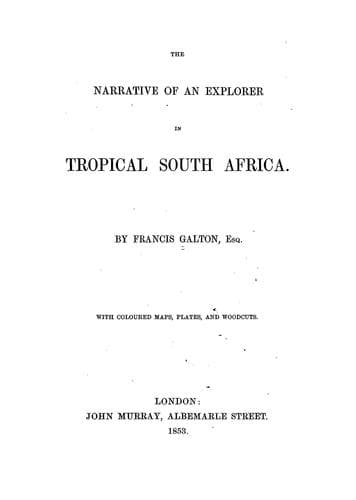
The narrative of an explorer in tropical South AfricaGalton, Francis
History
The narrative of an explorer in tropical South Africa
Galton, Francis
South Africa -- Description and travel
We passed rapidly through Otjimbinguè, for there was no grass there, and
on the 21st of November reached Tsobis. Now I felt safe; happen what
might, I could reach the Bay in time to save the ship. The oxen were very
thin and weak, but there were plenty of reeds in the Swakop for them to
eat. As we moved down the Tsobis River, by the place where the first
giraffe was shot, some natives warned us of the next watering-holes at
the mouth of the river, for the Ghou Damup had poisoned the water to kill
the buffaloes that then were there. We had arrived at the Swakop before
we were aware of it; the oxen rushed, as they often do, wildly to the
watering-holes, and though we drove them away before any one had drunk
enough to hurt them seriously, yet one dog was very nearly killed. He
rolled about in agonies from the poison. The oxen became still weaker,
the change of food from dry grass to reeds quite upset them, so that we
had to rest the following day.
_November 24th._—We could just move on through the sand with hard
struggling, and the next day we arrived at a place where old Piet was
encamped, and were luxuriously treated with milk. We slept at Annāas on
the 27th, at Daviéep on the 28th; there was not a relic to be found of
my poor horse and mule that the lions had eaten there. We now travelled
principally by night. From Daviéep we arrived safely at Oosop, after
rather a hazardous jolting which the waggon underwent in going down
a steep bank, and we were then only one day’s journey from the Bay.
Andersson rode directly across the plain to Scheppmansdorf, to make
inquiries after news and to rearrange some of the packages. He was
to send back word to me immediately on his arrival. There was plenty
of grass at Oosop, and I stayed there two days, and then went on to
Hycomkap, where Andersson’s messenger reached me, saying that the ship
had not arrived.
As we had slept at Oosop on the 29th, we could, if I had chosen, have
reached the Bay on the 30th. We left ’Tounobis October 10th, so that the
entire journey would have taken us fifty-three days; but, had the country
been in a good state for travelling, I am sure that I could have done it
in ten days less, or forty-three days. I had calculated on thirty-seven
days’ actual travel, and four of rest, or forty-one days. With a change
of oxen at Eikhams or Elephant Fountain, I think Lake ’Ngami ought to be
reached in fifty days from Walfisch Bay, and with a change at Otjimbinguè
and again at Elephant Fountain, a light well-driven waggon might do it in
forty days.
At Hycomkap we had some pretty foot-chases after gemsbok calves, and
killed a few. The whole number of oxen in the drove were now 133. Jonker
had still some to pay, when he received the mules.
Public-domain text, read in full here on John Shaqi.
Reviews
Reviews
No reviews yet
Be the first to share your thoughts on this work.
Elsewhere in the archive
Join the Discussion
Join the discussion
Sign in to leave a comment or review.
Sign InorCreate an account