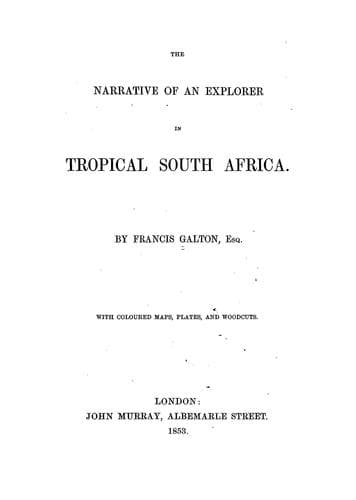
The narrative of an explorer in tropical South AfricaGalton, Francis
History
The narrative of an explorer in tropical South Africa
Galton, Francis
South Africa -- Description and travel
Christmas and New Year’s Day had passed, when, early in January, 1852,
as the morning haze cleared away, the sails of a schooner loomed large
before us; in a moment I was in my pontoon and paddled out to her, jumped
on board, and received my letters of a year and nine months’ interval.
They were not indeed unchequered by melancholy news; but for the
intelligence they conveyed of my own family circle I had every reason to
be grateful. Thus closed my anxieties and doubts. I had much indeed to be
thankful for. I had not lost one of my many men either through violence
or through sickness in the long and harassing journey I had made. It was
undertaken with servants who, at starting, were anything but qualified
for their work, who grumbled, held back, and even mutinied, and over whom
I had none other than a moral control. I had to break in the very cattle
that were to carry me, and to drill into my service a worthless set of
natives, speaking an unknown tongue. The country was suffering from all
the atrocities of savage war when I arrived, and this state of things I
had to put an end to before I could proceed. All this being accomplished,
I found myself without any food to depend upon, except the oxen that I
drove with me, which might, on any evening, decamp or be swept off in a
night attack by the thieving and murderous Damaras. That all this was
gone through successfully, I am in the highest degree indebted both to
Andersson and to Hans, for single-handed, I hardly know what I should
have done.
On the 16th of January I said my last adieu, and in company with Timboo,
John Williams, and John Morta, sailed away to St. Helena. The rest
remained in the country. Hans intended to make a venture in cattle and
ivory, and Andersson to investigate the natural history of the lake
district. Of the natural history of Damara-land he had made a complete
collection, but the barrenness of the country admitted of no great scope
to the naturalist. The flowers were very few and wretched-looking. I
really only know one that would look presentable in an English garden.
What few seeds I brought from Ovampo-land are now planted in the gardens
at Kew. My Ovampo fowls survived a stormy passage homewards, and laid
eggs constantly, until they came to English latitudes, and then they
all died; and my faithful cur, Dinah, is the only living animal of the
expedition, besides myself, that fate has as yet allowed to revisit
Europe.
THE END.
BRADBURY AND EVANS, PRINTERS, WHITEFRIARS.
FOOTNOTES
[1] I am informed that certain New Zealand tribes not only eat without
salt, but actually look upon it with distaste and aversion.
[2] Translation from Josè Joaquim Lopez de Lima’s work on the Portuguese
Settlements in Western Africa. 1846. (Page 196.)
Public-domain text, read in full here on John Shaqi.
Reviews
Reviews
No reviews yet
Be the first to share your thoughts on this work.
Elsewhere in the archive
Join the Discussion
Join the discussion
Sign in to leave a comment or review.
Sign InorCreate an account